
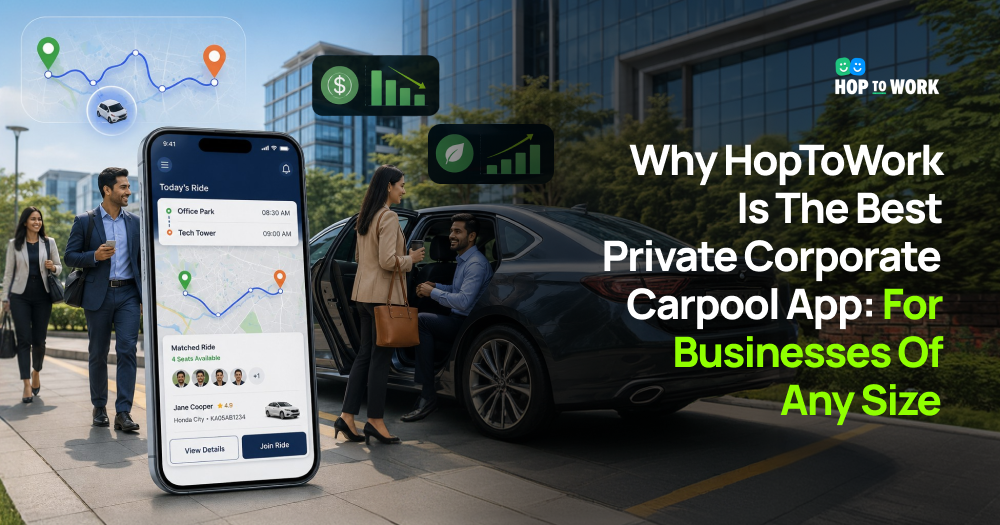
Every corporate HR leader evaluating a carpooling platform arrives at the same moment: a spreadsheet with four or five vendors, a set of capabilities that all look roughly similar on paper, and the difficult task of determining which platform will actually deliver what it promises at the scale and complexity their organisation requires. This guide cuts through that comparison by explaining specifically what HopToWork does differently as the best private corporate carpool app on the market today, not in the language of feature lists, but in the language of problems it solves that other platforms cannot.
Consider the CSRD auditor who requires GPS-measured trip data rather than estimates, the manufacturing HR director whose employees rotate between three shifts, the night-shift safety officer who needs to know that the SOS system works in a basement car park with no signal, and the CPO of a 50-person technology company who needs a carpooling benefit without a six-figure platform investment. HopToWork was built for all of these, simultaneously.
The Problem with "Good Enough" Carpooling Platforms
There is no shortage of corporate carpooling software in 2026. A procurement team comparing vendors will find a dozen platforms that offer an iOS and Android app, GPS tracking, a matching algorithm, a corporate admin panel, and some sustainability reporting. On a feature checklist, many of these platforms look equivalent. The differences emerge when you ask them to do what enterprise carpooling actually requires in practice.
"The question to ask any carpooling platform vendor is not "do you have GPS tracking?" but "what happens to the GPS tracking when a driver's phone is in a basement car park with no signal?" Not "do you have ESG reporting?" but "is your CO₂ calculation based on GPS-measured trip distance or postcode centroid estimation?" Not "do you support shift workers?" but "does your matching algorithm treat shift rotation week as a hard filter before scoring, or as a preference that can be overridden by route quality?" The answers to these questions separate enterprise-grade platforms from feature-list platforms that look similar until they fail."
The Capability Gap: Feature-List Platforms vs HopToWork
The table below compares how a typical employee carpooling platform handles six critical capabilities against what HopToWork actually delivers.
| Capability | Typical Platform | HopToWork | Why It Matters |
|---|---|---|---|
| GPS Tracking Reliability |
|
|
An SOS in a basement car park at 3am that only transmits "when the app has signal" is not a safety feature. HopToWork captures and transmits every SOS and GPS position regardless of connectivity. |
| ESG CO₂ Calculation |
|
|
A CSRD auditor verifying the CO₂ calculation methodology will find the difference immediately. Estimated data fails audit. GPS-measured data with documented methodology passes. |
| Shift Worker Matching |
|
|
A Day Shift driver matched with a Night Shift passenger is an operational failure. HopToWork's pre-filter makes this impossible. |
| SOS Offline Capability |
|
|
The most likely SOS scenario is low or no signal. An SOS that requires cellular data is not a real safety feature where night-shift employees need it most. |
| Adoption Programme |
|
|
67% of carpooling programmes plateau below 25% adoption without an active programme. HopToWork's adoption infrastructure converts registered users into daily carpoolers. |
HopToWork for Small and Medium Businesses: Enterprise Capability at SMB Scale
The assumption that enterprise-grade carpooling technology is only for organisations with 1,000+ employees is incorrect. A 60-person technology company, a 150-person healthcare clinic, or a 300-person logistics operation can deploy HopToWork and achieve meaningful carpooling adoption, measurable sustainability impact, and a transport benefit that genuinely differentiates their employer brand, at a cost structure that makes sense for their size. HopToWork is the best carpool app for small businesses because it provides the same core platform capabilities regardless of headcount.
What Small Businesses Actually Need from a Carpool Platform
Here is how HopToWork addresses the specific needs of smaller organisations as a purpose-built private employee carpool platform.
Quick Setup Without IT Complexity
A 60-person business does not have an enterprise IT team to configure SAML SSO and SCIM provisioning. The setup must be achievable by the HR manager or office manager without specialist support.
- Employee CSV upload with no SSO required
- Google Workspace or Microsoft 365 sign-in via OAuth, not enterprise SAML
- Admin portal requires no technical configuration
- Programme operational in 3 to 5 business days from employee upload
Affordable Pricing That Scales with Usage
At 60 employees with 40% adoption, the employer is paying for 24 active users. A per-employee-enrolled model that charges for all 60 even when only 24 are active is economically unworkable.
- Per-active-user monthly pricing
- Only employees who completed at least one trip in the month are counted
- Predictable costs that scale with actual programme usage, not registered headcount
Sufficient Matching Density at Small Scale
A 60-person office may have only 25 employees within carpooling distance. The matching algorithm must produce useful matches at this pool size, not require 500 employees to function.
- Residential cluster analysis identifies the carpooling-viable employee subset before launch
- Cold-start protocol (driver-first registration, guaranteed transport fallback) ensures early users get good matches
- Small pools still achieve over 70% match rate when seeded correctly
Safety Features Appropriate to SMB Duty of Care
A small employer carries the same duty of care obligations as a large one. The POSH Act applies to a 60-person manufacturing unit the same as it applies to a 6,000-person factory.
- Full safety stack available in all plans: driver verification, GPS tracking, SOS, deviation detection
- POSH Act compliance module available in India deployments of any size
- Safety features are not tiered by employer size
ESG Reporting That Means Something
A 60-person company with a sustainability commitment wants verifiable CO₂ data, not estimates, for their B Corp certification or stakeholder reporting.
- Same GPS-measured, per-vehicle-class CO₂ calculation as enterprise deployments
- Shareable monthly impact statement for social media and stakeholder reports
- B Corp sustainability certification data export available
The SMB Onboarding Journey
HopToWork's SMB onboarding is designed to get a carpooling programme operational in under a week, without technical expertise. This company carpool app setup process follows a clear sequence.
-
Day 1: Account Setup
The HR manager creates the HopToWork organisation account, uploads the employee CSV (name, email, work location, department), configures the subsidy amount, and sets the programme name and branding. Estimated time: 45 minutes.
-
Days 2 to 3: Driver Invitation
HopToWork sends driver invitation emails to a pre-selected group. Drivers download the app, complete their profile (home address, vehicle details, schedule, preferences), and are verified via licence upload or API, where available. Estimated driver onboarding: 10 minutes per driver.
-
Day 4: Passenger Launch
Once 10 to 15% of the eligible employee population is registered as drivers, HopToWork sends the all-employee invitation. The matching pool is seeded; early passengers requesting matches should see match options.
-
Days 5 to 7: First Matches and First Trips
HopToWork's customer success team monitors the first week's match quality (first-match NPS target above 30). Any flagged first matches are reviewed and adjusted before trips occur. Post-first-trip follow-up from the platform within 24 hours of every first trip.
HopToWork for Mid-Size Organisations: Full Programme Management at Corporate Scale
Mid-size organisations, typically 300 to 2,000 employees at one or several sites, are the sweet spot for corporate carpooling. They have enough employees to create good matching density, enough transport budget to make subsidies meaningful, enough corporate structure to benefit from the employer admin portal, and enough ESG reporting obligation to want verifiable sustainability data. HopToWork's Tier 2 deployment covers this segment comprehensively as a purpose-built employee transportation app.
Tier 2 Capabilities for Mid-Size Organisations
-
AI Matching
Six-dimensional algorithm with calendar integration, match history and repeat booking, first-match curation tools for the programme manager, and 90-day match quality tracking. Mid-size organisations have enough employees for the algorithm to produce consistently good matches. Calendar integration is particularly valuable for the hybrid-working mid-size tech or professional services company.
-
Corporate Admin Portal
Employee roster management with SSO optional at mid-size and CSV upload available, department and site tagging, programme configuration covering subsidy, matching pool, and schedule windows, subsidy budget tracking, and a monthly programme health email digest. One HR manager can run a carpooling programme for 800 employees with 2 to 4 hours per month of active management.
-
Employer-Grade Safety Dashboard
Live fleet map with all active trips, Level 1 to 3 alert routing, driver compliance monitoring, incident log, first-match NPS tracking, and a monthly safety summary. The dashboard is designed for a non-specialist who needs clear, actionable safety information.
-
Adoption Programme Tools
Full set includes calendar integration, first-match curation, guaranteed transport fallback, incentive engine covering milestones, 30-day commitment, peer referral, and team challenge, manager activation module, CO₂ leaderboard, monthly ESG impact cards, and dropout re-engagement automation. The 30-day commitment device, team challenge, and manager activation module are particularly effective at mid-size organisations where team identity is strong.
HopToWork for Large Enterprises: The Platform That Handles What Others Cannot
Large enterprises, covering 2,000 to 50,000 employees across multiple sites, countries, and workforce types, are where the difference between HopToWork and generic platforms becomes the difference between a programme that works at scale and one that works only in a pilot. As a full corporate mobility platform, the capabilities below are not available in any other enterprise carpooling platform to the same depth.
Enterprise-Exclusive Capabilities
-
Multi-Site Cross-Site Matching
Employees at different sites are matched across route corridors. Multi-destination support allows a driver going to Site A to carry a passenger to Site B if the detour is within tolerance. Generic platforms match within a single employer location. Cross-site matching requires PostGIS spatial analysis across multiple origin-destination pairs simultaneously, an architectural decision made at the data model level, not a configuration option.
-
Shift-Aware Matching with WFM Integration
Rotation matrix pre-filter, SAP WFM/Kronos UKG/Oracle WFM API integration receiving actual shift schedules including swaps and overtime, fatigue management lock, and post-shift rest enforcement. No generic carpooling platform has integrated with an industrial WFM system. Shift-aware matching requires a data model redesign, not a feature addition.
-
Hub-and-Spoke Industrial Deployment
Collection hub configuration, carpooling from residential areas to the hub, employer shuttle from hub to facility, unified two-leg booking, and platform-coordinated hub shuttle departure timing. Hub-and-spoke requires coordinating two separate transport modes in a single employee app. This is a distinct product capability, not a configuration option in a standard carpooling app.
-
Fleet Vehicle Integration with Telematics
Employer pool vehicles are included in the matching alongside employee vehicles. Samsara, Geotab, or Lytx telematics GPS data for fleet vehicles (more reliable than smartphone GPS) and EV incentive programme management. Telematics API integration requires established relationships with fleet management platforms and a data ingestion architecture that generic platforms do not have.
-
Enterprise SSO and HRMS Integration
SAML 2.0 and OAuth 2.0 with Microsoft Entra, Google Workspace, Okta, and Ping. SCIM 2.0 provisioning. Workday, SAP SuccessFactors, Oracle HCM. EHS system integration with Cority, Intelex, and Benchmark Gensuite. Enterprise IT procurement requires SAML SSO and SCIM as table-stakes. HRMS integration is required for auto-deprovisioning when employees leave.
The Enterprise Engagement Model
Large enterprise deployments of HopToWork follow a structured engagement model designed to de-risk the investment before commitment. Here is how to get a HopToWork demo and evaluate the platform at every stage.
-
Residential Cluster Analysis
Before any commercial commitment, HopToWork runs DBSCAN spatial clustering on the organisation's anonymised employee postcode data. The analysis produces a cluster-shift viability matrix: which residential clusters have sufficient same-shift employee density for viable carpooling matching. If the geography does not support viable matching, HopToWork says so before any commercial engagement proceeds. This reflects the principle that transport infrastructure decisions at an organisational scale are too consequential to rely on a trial-and-error approach.
-
Paid Proof of Concept
An 8 to 12 week engagement with a defined pilot cohort, typically 200 to 500 employees at one site, tests the full HopToWork stack with active customer success support. Match rate, first-match NPS, adoption rate, and CO₂ data are measured. The PoC report is the evidence package for the full deployment decision.
-
Phased Deployment with Route Sequencing
Full deployment opens routes in density order, highest-density clusters first, to ensure early programme participants experience high match rates from the first week. This phased approach produces better sustained adoption than a simultaneous all-employee launch.
HopToWork vs the Competition: A Meaningful Corporate Carpooling Software Comparison
Corporate carpooling vendor comparisons typically compare features that most platforms have: an app, a matching algorithm, GPS tracking, and an admin panel. The comparison that matters for enterprise procurement is different. It asks what happens when the capabilities are stress-tested against the specific operational challenges of the buying organisation. The six domains below represent the areas in which HopToWork's architecture delivers measurably better outcomes. This is the corporate carpooling software comparison that procurement teams should be running.
-
Matching Quality for Industrial Workforces
Generic SaaS platforms treat schedule as a preference. Shift rotation incompatibility is not enforced, leading to a high rate of operationally invalid matches at manufacturing sites. Consumer rideshare adaptations have no industrial workforce capability at all. HopToWork applies shift rotation pre-filter as a hard constraint, integrates with WFM APIs for actual schedule sync, enforces fatigue management, and produces zero operationally invalid matches in correctly configured industrial deployments. This is what makes HopToWork the best corporate carpool app for shift workers.
-
Safety for Night Shift Operations
Standard safety features on generic platforms (GPS tracking, basic SOS) have no night-specific protocol, no offline SOS, and no POSH Act compliance module. Consumer-grade safety is not designed for employer duty of care obligations. HopToWork provides automatic night protocol activation, offline SOS with SQLite storage and SMS fallback, women-only matching as a hard filter, Guardian link, automatic emergency contact notification, POSH ICC escalation, and night safety officer dashboard routing.
-
Adoption Programme Infrastructure
Generic platforms launch, send an email, and leave adoption to employee initiative. There is no built-in incentive engine, no first-match curation tools, and no manager activation module. Professional services are required for adoption support. HopToWork includes eight built-in adoption features: first-match curation, guaranteed transport fallback, configurable incentive engine, manager activation module, and a seven-programme health metrics dashboard. The target is 65% or more adoption compared to the 25% unmanaged plateau.
-
Scalability from SMB to Enterprise
SMB-optimised generic platforms lack SAML SSO, SCIM, and HRMS integration. Enterprise-only platforms price and package themselves out of reach for smaller businesses. Consumer apps with enterprise account tiers are not genuinely designed for either SMB programme management or enterprise IT integration. HopToWork operates as a single platform with tiered deployment: SMB (CSV upload, OAuth, 3-day setup), mid-size (SSO, HRMS integration, full admin portal), and enterprise (SAML, SCIM, WFM, EHS, multi-site, telematics). Pricing scales with usage, not artificial tier boundaries.
The ESG Advantage: Why HopToWork Wins the Sustainability Argument
Corporate sustainability teams have a problem that most carpooling platforms do not address: the difference between reporting sustainability and demonstrating it. As CSRD brings external audits to Scope 3 employee commuting disclosures, the distinction between estimating CO₂ savings and measuring them with GPS-confirmed trip data is the difference between a sustainability claim and a sustainability fact. For organisations building a genuine sustainable employee transportation solution, that distinction matters.
The ESG Data Quality Hierarchy
The table below shows the five levels of ESG data quality, their calculation methods, CSRD audit status, and where HopToWork sits.
| Level | CO₂ Calculation Method | CSRD Audit Status | HopToWork Tier |
|---|---|---|---|
| Level 1 | Employee self-declares as "a carpooler"; CO₂ estimated from average commute for job band; no per-trip data | Fails: no verifiable data | Not applicable (lowest quality) |
| Level 2 | Origin/destination postcodes captured; CO₂ estimated from postcode centroid distance; fleet-average factor applied | Likely fails: up to 35% error per trip; no per-vehicle factor; auditor cannot verify | Minimum standard on most generic SaaS platforms |
| Level 3 | Google Maps API estimates route distance at booking; fleet-average factor applied; distance stored per booking | Borderline: better than postcode, but fleet-average factor is unverifiable, and actual route is unconfirmed | Some generic platforms with better data architecture |
| Level 4 | GPS track recorded; actual distance from GPS positions; fleet-average factor applied | Conditional pass: GPS accepted; fleet-average factor must be disclosed and justified in methodology documentation | HopToWork minimum (when vehicle-class data unavailable) |
The Safety Advantage: Built for the Full Duty of Care Obligation
Every corporate carpooling platform claims safety features. HopToWork's safety advantage is not in having more features. It is in having designed every safety feature for the specific failure scenarios that occur in real corporate carpooling deployments, not the scenarios that look reasonable in a product demonstration. As a purpose-built employee transportation management system, HopToWork addresses the full duty of care obligation from day one.
The Safety Scenarios That Expose Platform Quality
The table below compares how generic platforms and HopToWork respond to the five most consequential safety scenarios in corporate carpooling.
| Safety Scenario | Real-World Context | Generic Platform | HopToWork |
|---|---|---|---|
| SOS in low-signal environment | Night shift employee presses SOS in a concrete multi-storey car park with zero cellular signal |
|
|
| Driver cancels 40 minutes before shift | Driver emergency; 3 passengers need to reach factory by 06:00; late arrival triggers disciplinary warning |
|
|
| No women drivers available on night route | Female employee with women-only matching selected; no women drivers in her residential cluster for the 22:00 shift |
|
|
| Unexplained route deviation at night | Employee in a carpool at night; vehicle on unexpected route for 8 minutes; employee is uncomfortable but has not pressed SOS |
|
|
| Fatigued driver after night shift | Driver completes Night Shift (22:00-06:00); informally agrees to drive a colleague at 08:00; only 2 hours rest |
|
|
Tiers & ROI: Value Across All Business Sizes
HopToWork's pricing model makes enterprise-grade carpooling accessible at every scale. A 50-person company pays for 50-person usage. A 500-person company pays for 500-person usage. A 5,000-person enterprise pays for 5,000-person usage, with per-active-user pricing that means the employer only pays for employees who actually use the platform in a given month. As an employee commute management software solution, the pricing tiers reflect the capability differences between deployment types, not artificial feature restrictions.
Pricing Tiers and Included Capabilities
The table below outlines HopToWork's three pricing tiers, their target organisations, pricing, and included capabilities.
| Tier | Target Org | Included Capabilities |
|---|---|---|
| Starter | 10–150 employees; single site; no shift workers; ESG reporting optional |
|
| Professional | 150–1,500 employees; single or 2 sites; hybrid working; ESG for B Corp or stakeholder reporting |
|
| Enterprise | 1,500+ employees; multiple sites; industrial/shift workforces; enterprise IT requirements |
|
The Total Cost of Ownership Comparison
Platform pricing is only part of the total cost of ownership for a corporate carpooling programme. The complete picture includes employer subsidies, programme management time, and the opportunity cost of poor adoption. A programme that achieves 15% adoption is not delivering 15% of its theoretical ROI. It is likely delivering negative ROI relative to the investment in launch and the expectations set with leadership.
-
Platform Licence Cost
Generic platforms typically charge $8 to $18 per employee per month or a per-trip fee, usually unaffected by adoption rate. HopToWork charges £12 to £45 per active user per month, and only active users are counted. The employer pays for value delivered, not registered headcount.
-
Programme Management Time
Without built-in adoption tools, programme managers on generic platforms typically spend 2 to 4 FTE-hours per week on manual outreach, spreadsheet tracking, and incentive coordination for a 500-employee programme. HopToWork's eight built-in adoption features reduce this to 1 to 2 FTE-hours per week. The dashboard surfaces all key metrics without manual reporting.
-
Adoption Performance Impact
At 15% adoption, which is the generic platform average without an active programme, ESG impact is minimal, parking demand reduction is minimal, and the talent benefit is marginal. At 55% or more adoption, which is the HopToWork target with its built-in adoption programme, ESG impact is substantial, parking demand reduction is meaningful, and the business case ROI is strongly positive.
-
Professional Services for Compliance
POSH Act compliance configuration, CSRD methodology documentation, and WFM integration are not available on generic platforms or come at a significant additional professional services cost. All of these are included in HopToWork's Enterprise tier with no additional professional services required for standard deployments.
The HopToWork Adoption Programme: The Architecture That Drives 65%+ Adoption
The reason HopToWork can claim a 65% or more sustained adoption target, where the industry averages 25%, is not that the matching algorithm is marginally better. It is that the adoption programme infrastructure is built into the platform as first-class product features. Every feature is designed with the specific adoption barrier it removes in mind. This is what separates a genuine corporate commute management platform from a booking tool with a corporate account tier.
The Eight Adoption Features and the Barriers They Remove
-
Calendar Integration
Removes habit disruption. Employees forget to book when manual booking requires intentional effort. Calendar integration makes match suggestions happen automatically without employee-initiated action. Employees with calendar integration take 2.4 times more trips than those who book manually. Proactive evening-before suggestions achieve a 67% same-evening confirmation rate.
-
First-Match Curation Tools
Removes poor first match risk. 73% of sustained users cite match quality as the primary retention driver. The recovery rate from a poor first match experience is below 12%. A programme manager review before the trip prevents dropout before it occurs. Programmes with active first-match curation achieve a first-match NPS above 35 compared to below 15 for uncurated programmes.
-
Guaranteed Transport Fallback Engine
Removes risk aversion. Employees will not register if they are unsure what happens when their match cancels. Guaranteed fallback removes this risk from day one. Registration rates at launch are 35 to 40% higher when a guaranteed fallback is communicated. Activation rate drops below 2% after the first 30 days as network density increases.
-
Configurable Incentive Engine
Removes habit disruption at specific adoption stages. Pre-launch earns a registration reward, first trip earns a meaningful reward, 30 days of consistent use completes a commitment device and triggers a reward, and advocacy earns a peer referral reward. Each incentive is matched to a specific barrier at a specific stage. The 30-day commitment device produces an 8-trip threshold achievement in 71% of users who enrol.
-
Manager Activation Module
Removes the social permission barrier. Employees who see their manager as an active carpooler adopt at 2.3 times the rate of employees whose manager is silent. The module gives programme managers the tools to activate their manager network without requiring individual outreach to each manager. Departments with active managers show 2.3 times higher registration and meaningfully higher first-trip conversion.
-
Gamification Engine
Removes motivation fade. Incentives sustain adoption in the habit formation phase. Community mechanics sustain adoption in the regular use phase when financial motivation has faded. Team challenges produce a 35 to 50% registration spike. 40% of challenge participants continue after the challenge ends. The CO₂ leaderboard increases monthly trips for sustainability-motivated employees by 18%.
-
Dropout Re-Engagement Automation
Converts dormant ex-users, the highest-conversion re-engagement segment. Automated Day 14 and Day 30 prompts, plus a champion outreach tool, convert 15 to 25% of dormant users back to active. Champion personal outreach converts at 4 to 6 times the rate of automated corporate email. The Day 14 prompt achieves a 22% re-activation rate among no-first-trip registered users.
-
Seven Programme Health Metrics Dashboard
Removes invisible decline. Programmes that measure only total trips cannot detect the early warning signals of decline until the decline is well advanced. The seven metrics are first-match NPS, Month 3 retention, match rate, driver-passenger ratio, trips per active user, CO₂ completeness, and dropout reactivation. These are leading indicators that trigger intervention before the trend becomes irreversible. Programmes with active metric monitoring intervene 4 to 6 weeks earlier on declining metrics than programmes monitoring trip counts only.
Choosing HopToWork: What to Expect at Every Stage of the Decision
The decision to deploy HopToWork should be based on evidence, not on this article. The evidence comes from the residential cluster analysis (does the organisation's geography support viable carpooling?), the platform demonstration (does the platform do what it claims?), and the paid proof of concept (does it work for this specific workforce?). HopToWork's engagement model is structured to provide each of these evidence points before a full deployment commitment is required. This is the right way to evaluate any employee transportation management system before committing to a full rollout.
The Pre-Decision Evidence Checklist
-
Residential Viability Analysis
Request a complimentary residential cluster analysis from HopToWork by providing anonymised postcode data for employees at your target site. This answers: Does the employee residential geography support viable carpooling? Which clusters have sufficient same-shift density for an over 70% match rate? What is the expected matching pool size at different adoption levels?
-
Platform Capability Demonstration
Request a live platform demo with realistic data, not a pre-recorded video. Bring the specific challenge questions from this article. This answers: Does the shift-aware matching pre-filter work as described? Can it generate the CSRD auditor data export? What happens when SOS is pressed offline? Does the guaranteed fallback activate automatically?
-
Reference Check from a Comparable Deployment
Request a customer reference from a deployment with similar characteristics, covering a similar size, a similar shift pattern if applicable, and similar ESG reporting requirements. This answers: what was the actual match rate after 60 days? What was the first-match NPS? Did the ESG data satisfy the sustainability team's reporting requirements? What was the adoption rate at 6 months?
-
Paid Proof of Concept
Commit to an 8 to 12 week PoC at one site or a defined employee cohort and measure match rate, first-match NPS, adoption rate, and CO₂ data quality. This answers: Does HopToWork produce the outcomes it claims in the specific context of this organisation? Is the first-match NPS above 30? Is the CO₂ data at Level 5 quality? What adoption rate did the PoC achieve, and is it on track for the 55% or more sustained target?
-
Total Cost of Ownership Analysis
Request HopToWork's TCO comparison tool and input the actual parking space cost at the site, the actual average salary for the employee population, the current shuttle cost if applicable, and the target adoption rate. This answers: what is the total net ROI of a HopToWork deployment at this site, including platform cost, subsidy cost, programme management time, parking demand reduction, fuel cost saving for employees, ESG reporting value, and talent retention effect?
The Four Questions Every HR Leader Should Ask Before Choosing a Carpool Platform
-
Question 1: ESG Data Quality
"Is your CO₂ saving calculation based on GPS-measured trip distance or postcode-centroid estimation? Can you produce the ESRS E1 methodology documentation that our ESG auditor will request?" The correct answer is GPS-measured with documented accuracy and methodology, and the ESRS E1 document is generated automatically. If the vendor hesitates or deflects to "our sustainability report is very comprehensive", the underlying data is estimated.
-
Question 2: Offline SOS
"What happens when an employee presses SOS in a basement car park with no cellular signal? Walk me through exactly what the platform does." The correct answer: SOS is stored locally in SQLite at the moment of tap, GPS position is captured and stored locally, push notification is queued at FCM, SMS is queued at Twilio, and all notifications are delivered when signal returns. If the vendor says "the SOS sends to our safety team immediately" without addressing what happens when there is no signal, the SOS fails in the most likely night-shift safety scenario.
-
Question 3: Shift-Worker Matching
"Do you have a manufacturing client where employees work rotating three-shift patterns? Can you show me that employees on incompatible rotation weeks are never matched?" The correct answer is a live demonstration in a test account with ABC rotation configured, where an attempt to create a match between two employees on incompatible rotation positions is refused by the platform before any scoring occurs. If the vendor offers a demo where incompatible employees are scored but ranked lower, the pre-filter is not implemented.
-
Question 4: Adoption Infrastructure
"Without any professional services engagement, what tools does the platform give my programme manager to curate first matches, activate managers, and re-engage dormant users?" The correct answer is a live walk-through of the first-match curation dashboard, the manager activation module with department-level metrics and team challenge console, and the dropout re-engagement tool in the admin panel. If the vendor's answer is "we offer programme management consulting services", the adoption tools are not built into the platform.
HopToWork: The Corporate Carpool Platform That Earns the "Best" Label
The "best" label in enterprise software is easy to claim and hard to earn. For HopToWork, the claim rests on six specific capabilities where the platform demonstrably outperforms every alternative: shift-aware matching that enforces rotation compatibility at the data model level, ESG reporting with GPS-measured data and uncertainty quantification that satisfies CSRD external audit, safety architecture with offline SOS and POSH Act compliance built in from launch, industrial deployment capability with WFM integration and hub-and-spoke configuration, adoption programme infrastructure that targets 65% or more sustained participation, and compliance pre-configuration across 47 jurisdictions.
For businesses of any size, the evaluation should follow the evidence. The residential cluster analysis tells you whether the geography supports viable carpooling. The platform demonstration tells you whether the capabilities are real or aspirational. The paid proof of concept tells you whether the adoption programme works for this specific workforce. HopToWork's willingness to provide the cluster analysis before any commercial commitment, and to scope a paid PoC before full deployment, reflects the same confidence in the platform that the evidence in this guide is designed to convey.
Corporate carpooling in 2026 is not a nice-to-have benefit. It is the intersection of ESG compliance, talent strategy, safety obligation, and operational cost management. The platform you choose determines whether your carpooling programme is an asset or a liability across all four dimensions. This is what a genuine private corporate carpool solution looks like in practice.
HopToWork is developed by Mobisoft Infotech, a product engineering company specialising in corporate mobility platforms, transportation management systems, and enterprise-grade mobile applications, including ride sharing platform development. HopToWork is available as an enterprise SaaS subscription, a white-label deployment for organisations wanting a proprietary branded platform, and a custom-configured solution for complex multi-site, multi-jurisdiction deployments.
Contact us to request a residential cluster analysis for your site, a platform demonstration, or a paid proof of concept proposal.
Frequently Asked Questions
Why is HopToWork the best private corporate carpool app?
HopToWork wins on six specific capabilities that other platforms cannot match:
- Matching intelligence: six-dimension AI matching with shift rotation pre-filter; incompatible shift workers are categorically excluded from matching, not just ranked lower
- Safety architecture: offline SOS (SQLite local storage), government API driver verification, POSH Act compliance, and night safety officer dashboard routing
- Industrial operations: WFM integration, hub-and-spoke deployment, and fleet vehicle integration built into the data model, not layered on top
- Built-in adoption: eight adoption features targeting 65%+ sustained participation, not professional services add-ons
Can small businesses use HopToWork, or is it only for large enterprises?
HopToWork serves businesses from 10 to 50,000+ employees with genuinely different deployment configurations at each scale. For small businesses, the Starter tier provides:
- CSV employee upload; no SSO required
- Google/Microsoft OAuth sign-in
- Set up by any HR manager in 3 to 5 days without technical support
- Per-active-user pricing; only trip-taking users counted
- Full safety stack and GPS-measured CO₂ calculation at all plan levels
A 60-person tech company or 90-person healthcare clinic can have a production-grade carpooling programme running before the start of the next month. The safety architecture and ESG reporting quality are the same at all scales. Only deployment complexity scales with size.
What is the HopToWork guaranteed transport fallback, and why does it matter?
The guaranteed transport fallback ensures employees never miss a shift because their match is cancelled. When a driver cancels within the configured notice window (default: 90 minutes before trip start):
- Taxi credit auto-applied to each affected passenger account
- Push notification and SMS with a one-tap booking link sent immediately
- The dispatcher and programme manager were notified
- Driver incident counter updated; 3 cancellations in 90 days trigger driver review
No manual intervention required. This is the single most effective barrier to adoption removal in the platform. Registration rates at launch are 35 to 40% higher when the guaranteed fallback is prominently communicated.
How does HopToWork's shift-aware matching work for manufacturing facilities?
The matching engine applies a mandatory pre-filter before any scoring: employees on incompatible shift rotation positions are categorically excluded, not ranked lower. The shift data model stores shift_pattern_code, shift_start_time, shift_end_time, rotation_week, and rotation_cycle_length.
- Pre-filter calculates each employee's shift type on the proposed trip date from the rotation matrix.
- Only employees on the same shift type with overlapping start times (within ±10 minutes) are scored.
- Post-shift driving lock: driver unavailable for 8 hours after shift end
- Pre-trip fatigue acknowledgement required for night shift drivers
These are enforced at the data model level. No workaround or override is available.
How quickly can HopToWork be deployed?
- Starter (10 to 150 employees, no SSO, single site): 3 to 5 business days from employee CSV upload to first matches.
- Professional (150 to 1,500 employees, OAuth SSO, single or dual site): 3 to 4 weeks, including SSO configuration, residential cluster analysis, driver recruitment, and first trip
- Enterprise (1,500+ employees, SAML/SCIM, HRMS, and WFM integration): 16 to 30 weeks, including residential cluster analysis, PoC design, paid proof of concept (8 to 12 weeks), integrations, safety team training, and phased deployment
Most common delay in enterprise deployments: HRMS data mapping and WFM integration configuration (4 to 6 weeks), and driver recruitment reaching the 12 to 18% target before passenger launch (2 to 3 weeks).


Nitin Lahoti is the Co-Founder and Director at Mobisoft Infotech. He has 15 years of experience in Design, Business Development and Startups.