
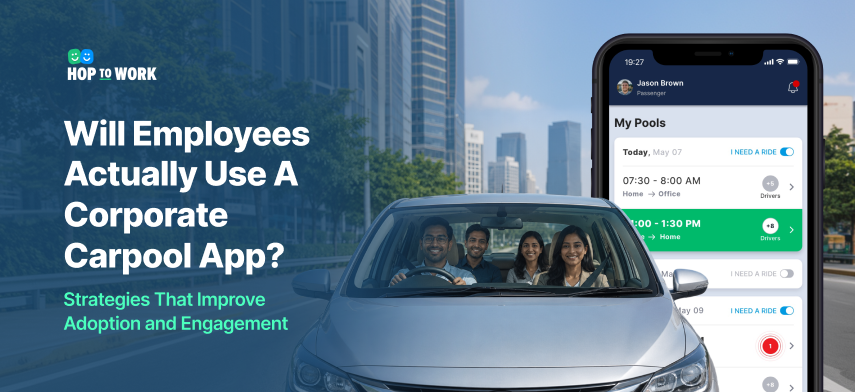
Most corporate carpooling programmes do not fail because the technology breaks. The platform works, the matching algorithm runs, and the GPS tracks every trip. The programme fails because 30% of employees sign up, 18% take one trip, and by Month 3, only 9% are still active.
That is not a technology problem. That is a programme design problem.
Specifically, organisations treat the employee transport management system launch as the finish line. Send the company-wide email, build the landing page, and wait for adoption to follow. It does not follow, because behaviour change does not work that way. Sustainable adoption requires deliberate design at every stage, from the first match to the sixth month.
This guide covers what that design looks like in practice. The incentive structures that actually work. The manager activation strategy most programmes skip. The match quality investments that determine long-term retention. The community mechanics, the onboarding window, the re-engagement playbook, and the metrics that tell you whether your programme is growing or quietly dying.
The organisations that have achieved 55 to 70% sustained adoption did not get there by spending more on incentives. They got there by treating the adoption programme with the same rigour they would apply to any product launch.
Why Most Corporate Carpooling Programmes Never Get Off the Ground?
Understanding why programmes fail is the prerequisite for designing one that succeeds. The failure patterns repeat across industries and geographies. They do not reflect the difficulty of the carpooling concept. They reflect predictable mistakes that are entirely avoidable.
These lessons are particularly relevant for organisations investing in sustainable transportation solutions, where long-term employee participation determines whether environmental and commuting objectives are actually achieved.
The Adoption Curve Nobody Talks About
Every employee carpooling programme follows a recognisable pattern. Knowing the stages in advance is what separates programmes that intervene in time from those that quietly disappear from the benefits page.
-
Launch Enthusiasm (Weeks 1 to 4)
Sign-up rates look promising. Early adopters, sustainability-motivated employees, and people who already know potential carpool partners rush in. Participation sits between 25 and 35% of the workforce. Everything feels like it is working.
-
Initial Usage (Weeks 2 to 6)
First matches are made. Some are excellent. Others are awkward, poorly timed, or add 25 minutes to the commute. There is no active programme support for poor first experiences. The cracks begin.
-
The Adoption Dip (Weeks 4 to 10)
This is where most programmes lose. Initial motivation fades. Poor first-match experiences produce dropouts. Participation drops to 12 to 20%. Programme managers notice the plateau but have no intervention playbook ready.
-
Plateau Without Management (Months 3 to 6)
Only committed early adopters remain. Participation stabilises between 8 and 18%. HR reports numbers below the original business case. Confidence in the programme erodes. Some organisations cancel at this point, which is exactly the wrong time.
-
Growth With Management (Months 4 to 12)
Active intervention changes the trajectory. Incentive refreshes, manager activation, community mechanics, and targeted re-engagement push participation to 35 to 60% sustained adoption. Once network density reaches a critical threshold, the programme becomes largely self-sustaining.
The Five Root Causes of Adoption Failure
These are not theories. They are the same five problems that appear, in some combination, in almost every programme that plateaus.
-
Poor First Match Experience
The employee gets matched with someone whose schedule does not align, whose vehicle is uncomfortable, or whose route adds significant time. They do not try again. The platform gets blamed. The algorithm is rarely the real problem. Cold-start data is sparse. Early matches need human curation.
-
Insufficient Driver Supply
Most employees sign up as passengers. Few sign up as drivers. Because of this, the match rates drop. Passengers receive "no match available" and stop checking the app. The fix is a driver-first recruitment campaign before passenger launch, not after.
Organisations that already use fleet mgmt software for transportation planning can often identify driver availability patterns and commuting hotspots more effectively, helping improve match rates during the early stages of programme rollout.
-
Communication Without Relevance
A company-wide email goes out, but the reminder follows two weeks later. Employees who did not register in the first wave never receive a personalised reason to try. Registered but inactive employees receive no outreach. The programme assumes it has been adequately communicated, which clearly isn't the case.
-
No Social Proof at Scale
Employees hear about the programme from HR. They do not hear from colleagues they actually trust. Participation starts to feel like compliance rather than a genuine choice. Peer advocacy from 10 to 15 enthusiastic early users outperforms any number of corporate emails.
-
Incentive Misalignment
A £5 Amazon voucher does not change a deeply ingrained habit. The right incentive is not a bigger transactional reward. It is a structural benefit that removes the specific barrier each employee faces.
Match Quality Is the Only Metric That Actually Retains Employees
Here is the finding that reframes the entire adoption conversation. More than 70% of sustained carpool programme participants cite match quality as the primary reason they continue. Not the incentives. Not the employer brand. Not the app design.
Match quality.
Every other investment in this guide is secondary to getting this right.
What Match Quality Actually Means
Match quality is not a single score. It is five things working together.
-
Schedule Accuracy
The driver arrives within five minutes of the scheduled pickup. The pickup time fits the employee's actual morning, including any early meetings. Calendar API integration is what makes this reliable at scale.
-
Route Quality
The journey adds no more than 10 to 15 minutes compared to the employee's solo commute. The pickup point is within a reasonable walking distance. Matches with detour times above 15 minutes need a programme manager review before confirmation.
-
Interpersonal Fit
A quiet passenger matched with a chatty driver creates discomfort. It does not get reported. It just becomes a reason not to book again. Post-trip feedback needs to capture the interpersonal experience explicitly, not just the logistics.
-
Vehicle Comfort
A clean vehicle with an appropriate size and a comfortable temperature seems basic. They are also a difference between a passenger who books again and one who does not. Vehicle comfort should be a named feedback category from day one.
-
Communication Reliability
The driver and passenger communicate within the platform before the trip. No personal phone numbers needed. Pre-trip messaging predicts on-time pickup more reliably than any other signal.
The First Match Curation Protocol
The first match is the highest-stakes moment in any employee's carpooling journey. A poor first experience produces a dropout that almost no subsequent intervention can reverse.
Employees who have a poor first match have less than a 12% chance of becoming regular users. That number makes active curation non-negotiable.
Here is what it looks like in practice.
-
Daily Review for the First 60 Days
A programme manager or carpooling champion reviews upcoming first-time matches for the next three days. For each match, they check route detour time, schedule compatibility within 30 minutes of any calendar block, and preference compatibility score. Anything below 70% compatibility gets flagged.
-
Active Intervention on Flagged Matches
For flagged matches, the programme manager contacts the passenger or driver before the trip. They offer to adjust the pickup point, confirm the schedule works for that specific morning, or check whether the preference mismatch is acceptable. This prevents a poor experience before it happens.
-
Post-First-Match Follow-Up
Within 24 hours of every first trip, send a personalized check-in. Capture a five-star rating and an optional comment. Respond personally to any one-to-three-star ratings within 24 hours. Understand what went wrong. Adjust the next match recommendation accordingly.
-
Tracking First Match NPS
A healthy programme has a first match Net Promoter Score above 30. Below 10 signals a systemic quality problem. That problem will prevent sustained adoption regardless of everything else in the programme.
Incentive Design That Actually Changes Behaviour
The question is not how much money to offer. It is which incentives address which specific barriers at which stage of the adoption journey.
Most workplace ridesharing platforms offer a transactional incentive that misses the point entirely. A gift card for the first trip does not address why the employee has not taken it. It just rewards the ones who were going to try anyway.
Four Adoption Barriers and the Right Responses
Risk Aversion
- What employees think: If I commit to carpooling and there is no match, I will be late or stranded.
- Ineffective response: A £5 voucher for the first trip.
- What actually works: A guaranteed transport fallback. If no match is available or the match cancels, the employee automatically receives a taxi credit. Communicate this guarantee before launch. The guarantee removes the barrier, not just rewards the behaviour.
Habit Disruption
- What employees think: My current commute is a known quantity. Carpooling requires trusting a new system and accepting reduced independence.
- Ineffective response: A one-time sign-up reward.
- What actually works: A 30-day commitment device. Ask employees to try carpooling for 30 days, not just once. Frame it as an experiment with an opt-out. Offer a meaningful benefit for completing the trial. Three weeks of regular carpooling is enough to form a durable habit.
Social Discomfort
- What employees think: Carpooling means sharing personal space with a colleague I may not know well.
- Ineffective response: A financial reward that ignores the social dimension entirely.
- What actually works: Match transparency. Before accepting a match, employees see the other person's profile, photo, work department, and compatibility score. The stranger becomes a known person. For established teams, team-based matching lets employees start within their own group before expanding to the wider pool.
Convenience Comparison
- What employees think: My car is already in the garage. Coordinating with another person takes effort. Driving is just easier.
- Ineffective response: A small financial reward that does not change the convenience equation.
- What actually works: Structural convenience improvements. A parking pass reserved for the carpool group. Priority lane access at the facility gate. App-based coordination that requires zero phone calls. Make carpooling easier, not just financially rewarding.
Incentive Architecture by Adoption Stage
The right incentive depends on where the employee sits in the adoption journey.
| Stage | Target Behaviour | Incentive Type | Example |
|---|---|---|---|
| Pre-launch | Register and complete your profile | Recognition | "Founding Carpooler" badge; team leaderboard for department registration rate |
| First trip | Complete the first carpooling trip | Risk removal and meaningful reward | Guaranteed fallback; £15 to £25 fuel voucher; employer charitable donation |
| Habit formation (30 days) | Complete 8 or more trips in the first 30 days | Structural benefit | Preferred parking; monthly transit pass; personalised CO₂ impact report |
| Regular use (3 to 6 months) | 8 or more trips per month consistently | Community status | Carpooling level badge; monthly CO₂ statement shared with team |
| Advocacy (6 or more months) | Actively recruit a new carpooler | Peer reward | £20 fuel voucher for both advocate and recruit on recruit's third trip |
The pattern here is important. Early-stage incentives remove barriers. Later-stage incentives build identity and community. Financial rewards do the heavy lifting at the start. Status and recognition sustain participation after financial motivation fades.
Manager Engagement Is the Adoption Multiplier Most Programmes Miss
The single most consistent predictor of high carpooling adoption in a department is whether the line manager actively endorsed and personally participated in the programme.
Not whether they mentioned it in a team meeting. Whether they used it and said so publicly.
This finding, consistent across multiple corporate mobility solutions studies, points to a fundamental principle of workplace behaviour change. Employees adopt behaviours their manager models and explicitly endorses, particularly when the behaviour requires social cooperation, as carpooling does.
The Manager Activation Programme
-
Manager Pre-Briefing
Two to three weeks before launch, run a dedicated 30-minute briefing for all line managers. Cover what the programme is, why the organisation is running it, and what managers are actually being asked to do. The task is to model participation, not manage the programme. Managers who are briefed properly report 2.3x higher team registration rates compared to departments without briefing.
-
Manager Early Registration
Every manager completes their platform profile before the programme goes live to their teams. When a manager can speak from personal experience at launch, the team takes notice. A completed manager profile signals that this is a programme the organisation takes seriously.
-
Manager Public Participation
Ask managers to share their first carpooling experience on the company intranet or internal messaging platform within the first two weeks. A brief post about who they matched with, how it went, and what they noticed. This reaches employees who did not act on the launch email. It creates authentic social proof that no corporate communication can replicate.
-
Department Metrics in Manager Reporting
Share department-level adoption metrics in the manager's regular people analytics or sustainability reporting from Month 2. Registration rate. Active user rate. CO₂ impact. Treat carpooling adoption as a people programme metric. Managers who see their department's numbers relative to peers take active steps to improve participation.
-
Team Challenge Activation
At Month 2 to 3, when initial enthusiasm plateaus, run a time-limited team challenge. Four weeks. The department with the highest new user count or the highest CO₂ saving wins a team experience. Managers organise and communicate the challenge within their teams. Team challenges produce a 35 to 50% spike in registration and first trips. Roughly 40% of challenge participants continue after the challenge ends.
The Department Champion Network
Line managers set the tone. Champions carry it into the day-to-day.
A champion network is a small group of enthusiastic early users who act as the human face of the programme within their department. They do not manage anything. They model the behaviour and answer peer questions.
-
Selecting Champions
Identify 10 to 15 employees across departments who are active early users with a positive first match experience and a willingness to be named as a contact for peer questions. These should not be HR or communications staff. They should be regular employees whose peers would see as credible voices on the actual commute experience.
-
Enabling Champions
Provide each champion with honest answers to frequently asked questions, including the uncomfortable ones about what happens if the match cancels or if the journey feels awkward. Share the latest programme metrics they can use in peer conversations. Offer a small recognition benefit, such as priority parking or quarterly acknowledgment at all-hands.
-
Champion Outreach
Each champion proactively reaches out to three to five colleagues who registered but have not taken their first trip. A personal message from a peer converts at four to six times the rate of a corporate re-engagement email from HR. That gap is significant enough to build a programme design around.
-
Sustaining Champions
Champions who receive no feedback on their advocacy impact quietly step back. Close the loop. Show them the CO₂ savings their recruitment produced. Recognise their contributions publicly. Champions who can say "I convinced eight people to try carpooling" have a concrete reason to keep going.
The 14-Day Onboarding Window That Decides Everything
Employee behaviour in the first 14 days after signing up is the strongest predictor of Month 3 activity. Employees who take at least three trips in their first two weeks are 3.8 times more likely to be active at Month 3 than those who take one or none.
That single finding should redesign every onboarding flow in workplace carpooling programmes.
The Onboarding Journey Day by Day
-
Day 0: Registration
The employee creates an account via SSO, enters their home address, and selects their office location and work schedule. The platform shows them how many potential matches exist in their area. The programme sends an automated registration confirmation with a quick-start guide, and the match counts as a motivating data point.
-
Days 1 to 2: Preference Capture
The employee adds commute preferences such as conversation style, music preferences, and vehicle type. The platform explains why each preference improves match quality. An automated prompt flags if the profile is below 80% complete. Higher preference completion produces better first matches. Better first matches produce higher retention.
-
Days 2 to 5: First Match Request
The employee requests a match for a specific date. The platform shows the top three match candidates with compatibility scores, profile previews, and estimated detour times. The programme manager receives an alert. This first match request is the moment for active curation before confirmation.
-
Days 5 to 7: Pre-Trip Communication
The employee messages their match partner to confirm pickup details. The platform sends an automated driver briefing with the pickup point photo and access instructions. A champion sends a personal note. "Your first trip is coming up. Any questions? Here is what to expect."
-
Days 7 to 10: First Trip
Real-time tracking. Driver photo on the arrival screen. Post-trip rating prompt within one hour. Within 24 hours, a personal check-in from the programme manager or champion. "How was your first trip?" The feedback is captured while the experience is fresh.
-
Days 10 to 14: Second Booking
If no second booking appears by Day 10, the champion sends a personal re-engagement message. If the first trip rating was positive, the same match is offered as a priority option for the second trip. The goal is three trips in the first 14 days. That is the threshold where habit formation reliably begins.
-
Days 14 to 30: Regular Use
The algorithm now has enough data to self-improve. Match history becomes visible. Personalised CO₂ saving accumulates. At Day 30, if the employee has completed eight trips, they receive the commitment device completion reward. A personalized CO₂ impact card is shared on the company social channel, with consent.
Onboarding Resources That Actually Get Used
Most corporate onboarding materials are text-heavy guides that employees never read. Three questions drive every first-time user's decision.
-
Question One: Who Will I Be Matched With?
A 90-second video featuring an actual employee describing their first carpooling experience. Not an actor. Not stock footage. Someone from the organisation talking about who they were matched with, how the pickup worked, and why they kept going. Peer testimony at this stage is more persuasive than any feature walkthrough.
-
Question Two: What If Something Goes Wrong?
A clear two-minute explainer covering the safety features and the guaranteed transport fallback. Many employees do not register because they are not sure what happens if the driver does not arrive. Answer this explicitly before the employee has a reason to invoke it.
-
Question Three: How Does the App Work?
The platform walkthrough. Important for reducing booking friction. But this is the lowest-priority onboarding resource, despite being what most organisations build first. Build the peer testimony and safety explainer first.
Gamification and Community Mechanics That Build Real Habits
Gamification in employee transportation programs is not about turning commuting into a competition. It is about creating the social infrastructure that makes carpooling visible, recognised, and worth belonging to.
The distinction matters. Gamification that feels like corporate manipulation fails. Gamification that creates genuine community and tangible impact sustains long-term participation.
Gamification Elements With Evidence of Impact
-
CO₂ Impact Leaderboard
A live leaderboard showing CO₂ savings by department or team, refreshed weekly and visible on the company intranet or ESG dashboard. The leaderboard makes environmental impact tangible and comparative. Keep it at the department level rather than the individual level. Collective achievement framing reduces competitive pressure that can feel uncomfortable at scale.
-
Trip Milestone Badges
Visible badges on employee profiles for carpooling milestones. First trip. Ten trips. Fifty trips. One hundred trips. One year. Badges visible on the platform profile and optionally on the company directory. They create a visible social identity as a carpooler. Colleagues see the badges, ask questions, and the conversation does the recruitment work.
-
Team Challenges
Four to six week time-limited challenges where teams compete on a specific carpooling metric. Most new users per team. Highest team CO₂ saving. Highest match rate. Run challenges at Month 2 to 3, not at launch. Four weeks is the optimal duration. Long enough to form a habit. Short enough to maintain urgency.
-
ESG Personal Impact Statements
Monthly or quarterly personalised statements for each active carpooler. CO₂ saved versus a solo car. Fuel cost saved. Equivalent trees planted. Equivalent flights avoided. Shareable as an internal social post or included in the company ESG report. The statement connects daily behaviour to a larger purpose. Make it genuinely personalised to each employee's specific trips, not a generic estimate.
-
Driver Recognition Programme
Monthly recognition of top-performing drivers based on on-time rate and passenger satisfaction. Recognised in all-hands meetings, on the intranet, or with practical benefits like priority parking. Drivers who feel recognised for service quality are more likely to maintain it.
-
Carpooling Community Channel
A dedicated Slack or Teams channel for the carpooling community. Trip stories. Match experiences. Route suggestions. CO₂ milestones. This channel should be employee-led, not HR-managed. Seed it with champion content in the first weeks. Let it evolve organically. The community it builds is harder to replicate with any incentive to spend.
Re-Engagement: Bringing Back Employees Who Tried and Stopped
Dropout is inevitable. The question is not how to prevent it entirely but how to identify the cause quickly enough to act on it, and how to bring former participants back before the programme loses critical mass.
Dormant ex-users are the highest-conversion segment in any commuter engagement campaign. They have already crossed the registration barrier. They have some experience with the product. They are far closer to re-engagement than a new recruit.
Dropout Types and the Right Re-Engagement Approach
-
No-First-Trip Registered Users
I registered more than 14 days ago. Zero trips. Profile possibly incomplete.
The most likely cause is that registration momentum faded before the first match was ever requested. Personal outreach from a champion within that 14-day window is the most effective intervention. "I noticed you signed up, but have not tried a trip yet. I can help set up your first match in two minutes."
-
One-Trip Stoppers
Took exactly one trip. Rated it one to three stars or left no rating. No further activity.
This is almost always a poor first match experience. Respond personally to the low rating within 24 hours. Ask specifically what went wrong. Offer a curated alternative match recommendation. Do not wait for them to re-engage spontaneously. They will not.
-
Seasonal Dropouts
Active for two to three months. Stopped around a life event. Moved house. Changed working pattern.
The commute route or schedule no longer matches previous matches. The profile data is stale. An annual profile refresh prompt handles this well. "Your home address or work schedule may have changed. Update your profile and see new match options."
-
Quiet Quitters
Active for several months. Activity gradually declined over six to eight weeks. No explicit reason given.
Match quality likely declined as a driver left the programme. The same matches became repetitive. A match refresh, offering a different driver, often resolves this. "Have you tried matching with someone new recently?" A community event invitation can also pull this group back in without feeling like a re-engagement campaign.
-
Life-Change Dropouts
Stopped after a company event. Office move. Policy change. Team restructuring.
The existing matching infrastructure no longer applies. Proactive outreach when context changes occur is the fix. Do not wait for affected carpoolers to rediscover the programme in the new context. Reach them first with new matching options built around the changed situation.
The Re-Engagement Communication Sequence
Generic re-engagement emails perform poorly. "Come back to carpooling!" has low open rates and even lower conversion. Specific, personalised re-engagement works meaningfully better.
-
Day 14 after the last trip
Automated but personalised push notification or email. "It has been two weeks since your last carpool. New matches are available on your route." Links directly to the match browser, not the app home screen.
-
Day 30 after the last trip
Champion's personal message asking if everything is going well and offering to help set up a new match.
-
Day 60 after the last trip
Programme manager outreach for employees who gave a low first-match rating. Specifically address the prior experience. Offer a curated, reviewed match recommendation.
-
Day 90 after the last trip
Profile refresh prompt. "Your carpooling preferences may have changed. Update your profile and see if your options have improved." A lower-commitment ask that reduces the psychological barrier to returning.
Programme Metrics That Tell You the Truth
Most workplace transportation solutions programmes are measured by total registered users or total trips completed this month. These metrics are insufficient for programme management. They do not reveal whether the programme is growing, plateauing, or declining until the decline is well advanced.
The seven metrics below provide leading indicators that allow intervention before a trend becomes irreversible.
The Seven Health Metrics
-
First Match NPS
Net promoter score from the post-first-trip survey. The best predictor of long-term retention from early experience. A healthy range is above 30. Below 10 signals a systemic first-match quality problem. Action trigger: review the matching algorithm configuration and investigate poor ratings individually.
-
Month-3 Retention Rate
Percentage of Month 1 first-trippers still active at Month 3. A healthy range is above 55%. Below 35% means habit formation is not occurring. Action trigger: Investigate dropout reasons and improve the incentive structure for the habit formation phase.
-
Match Rate
Percentage of match requests resulting in a confirmed match. A healthy range is above 75%. Below 55% means employees are frequently being told no match is available. This is the fastest driver of dropout after a poor first match experience. Action trigger: immediate driver recruitment campaign.
-
Driver-to-Passenger Ratio
Number of active drivers per 10 active passengers. The healthy range is two to three drivers per 10 passengers. Below 1.5 per 10 indicates a structural driver shortage. Action trigger: targeted driver incentives and onboarding review.
-
Average Trips Per Active User Per Month
How frequently are active users actually carpooling? A healthy range is above eight trips per month, approximately two per week for a four-day hybrid schedule. Below five means occasional use, not habitual use. Action trigger: Investigate schedule compatibility issues and consider introducing a commitment device programme.
-
CO₂ Data Completeness
Percentage of trips with GPS-measured distance and vehicle class data captured. Required for CSRD-auditable ESG reporting. A healthy range is above 95%. Below 85% creates data gaps that undermine audit credibility. Action trigger: Investigate why data is missing and check whether GPS tracking is being bypassed.
-
Dropout Reactivation Rate
Percentage of dormant users who return to active use after a re-engagement campaign. A healthy range is above 15% of contacted dormant users. Below 8% means the re-engagement approach is not working. Action trigger: switch from email to champion outreach and investigate whether the dropout cause is structural rather than attitudinal.
Monthly Programme Management Rhythm
A healthy employee commute management programme runs on a consistent monthly rhythm.
-
Week 1
Pull and review all seven dashboard metrics. Flag anything outside the healthy range. Identify the top three dropouts from the previous month and review available dropout reasons. Check any driver with three or more late arrivals and contact them for a performance conversation.
-
Week 2
Send the monthly CO₂ impact summary to all active participants, personalised by individual trip data. Send the department-level participation report to all line managers. Re-engage dormant users inactive for 14 to 30 days via automated platform message. Brief champions on this month's metrics and any notable programme stories.
-
Week 3
Run driver recruitment if the driver-to-passenger ratio is below the threshold. Review upcoming first-time matches for new registrants. Check in with champions to confirm they are still active and recognise their contributions.
-
Week 4
Programme team review covering adoption targets, budget, and subsidy expenditure. Update HR leadership on participation rate, CO₂ saving, and programme cost per active user. Plan the following month's activity.
-
Quarterly
Programme review with the executive sponsor. Employee satisfaction survey. ESG reporting data extract with methodology verification. Driver pool review for compliance gaps and persistent quality issues.
Technology Features That Directly Support Adoption
Not all platform features contribute equally to whether employees keep using a corporate carpool app. The six features below have the strongest evidence for adoption impact. They are the ones employees cite as the difference between a product they use daily and one they tried once.
Six Adoption-Critical Features
-
Calendar Integration
Employees with calendar integration enabled take 2.4 times more trips than those without it. The platform reads actual calendar events, including ad-hoc work-from-home decisions, and updates within 15 minutes of any change. Match suggestions go out proactively for confirmed office days the night before.
The common failure is that calendar integration exists as an optional feature that most employees never set up during onboarding. The integration itself needs to be a mandatory onboarding step, not a buried setting.
-
Real-Time Driver ETA and Tracking
Passenger anxiety about whether the driver is actually coming is the most common cause of first-trip abandonment. Real-time ETA with the driver's photo on the arrival screen, updating every 60 seconds, eliminates that anxiety before it becomes a dropout.
The implementation failure to avoid: showing a static scheduled pickup time rather than a live GPS-based ETA. That is not real-time tracking. It is a reminder.
-
Match History and Repeat Booking
Finding a match you are comfortable with and booking them again easily is the primary habit mechanism for regular users. Match history should be prominently displayed on the home screen with one-tap repeat booking for any specific date.
If repeat booking requires starting the matching process from scratch, regular users find workarounds, usually a personal WhatsApp message, or they stop booking entirely.
-
In-App Pre-Trip Messaging
Coordinating the pickup without sharing personal phone numbers reduces the social friction that stops many employees from committing. Pre-trip messaging within the platform, with quick templates for common situations, is a medium-to-high adoption impact feature that most implementations bury in settings where no one finds it.
-
Personal ESG Impact Dashboard
Not a primary adoption driver but a strong retention driver for sustainability-motivated employees. The dashboard needs GPS-measured CO₂ savings, not estimated figures. Employees who notice the numbers seem too round or too conveniently large stop trusting them. Credibility is everything here.
-
Guaranteed Transport Fallback In-App
The single most effective adoption barrier removal in any sustainable commuting solutions programme. If no match is available or the match cancels, the employee activates a taxi or cab credit in one tap, no phone call, no form, no delay.
The implementation failure that makes this feature useless: requiring the employee to contact HR or a dispatcher to activate the fallback. That barrier is too high at the moment of stress, 30 minutes before a shift starts with no ride confirmed.
The 90-Day Launch Plan
The first 90 days determine whether a corporate ridesharing programme reaches critical mass or plateaus below viability. The plan below builds the activities most organisations skip directly into the mandatory launch structure.
Week-by-Week Launch Calendar
-
Weeks Minus Four to Minus Two: Foundation
Run residential cluster analysis. Identify champion candidates. Brief all line managers in a 30-minute session. Configure the platform with employer-specific settings. Test the guaranteed transport fallback end-to-end. No employee communication yet. Build internal momentum among programme advocates before any public announcement.
-
Week Minus One: Driver-First Soft Launch
Recruit 30 to 50 volunteer drivers from early adopters. Ensure they complete full profiles and the app walkthrough. Confirm their routes cover the primary residential clusters. Send a driver-only invitation. "You have been selected as a Founding Driver. Your route will give colleagues a reliable commute option."
-
Week Zero: Public Launch
All-company launch communication from a senior sponsor, not HR alone. Every manager shares the programme in their team meetings this week. Champions introduce themselves in the carpooling community channel. The platform opens registration for all employees.
-
Weeks One and Two: First Match Experience
Daily first-match review. Post-first-match follow-up for every first-time tripper. Any poor first match rating addressed within 24 hours. Personalised outreach to registered employees who have not yet taken a trip.
-
Weeks Three and Four: Adoption Foundation
Review adoption metrics against targets. Address any residential cluster where the match rate is below 60%. Champion outreach to non-trippers. Calendar integration prompt for users who have not yet connected their calendar.
-
Weeks Five and Six: Momentum Maintenance
Identify and contact dropouts from the first two weeks. Run targeted re-engagement for one-trip stoppers. Review the first match NPS and investigate scores below 20. Automated re-engagement push notifications for users inactive for more than 14 days.
-
Weeks Seven and Eight: Team Challenge
Launch the first team challenge. Four weeks duration. The department with the highest new user count wins a team experience. Promote through all internal channels. Champion-led peer recruitment begins this week.
-
Weeks Nine to Twelve: Community and Recognition
First driver recognition event based on on-time rate and passenger satisfaction. Quarterly programme review with the executive sponsor. The 30-day trial completion reward triggers for eligible employees. Driver of the month recognised at the all-hands meeting. Quarterly CO₂ impact report shared on the intranet.
The Programme Design Is the Product
The platform is the enabler. The programme design is what employees actually experience.
An organisation that spends heavily on a best-in-class carpooling platform and deploys it with a launch email will consistently achieve lower adoption than one that deploys a simpler platform with structured programme management, active manager engagement, first-match curation, and a champion network.
The evidence is consistent. Match quality is the primary driver of long-term retention. The first match is the highest-stakes moment in the adoption journey. Manager endorsement is the strongest predictor of department-level adoption. The first 90 days determine whether the programme reaches critical mass or quietly stops growing.
Organisations that have achieved sustained 55 to 70% adoption did not get there by outspending competitors on incentives. They treated the employee transportation solutions programme with the same rigour they would apply to any product launch. Metrics with intervention triggers. Designated owners. A 90-day active management window. A clear plan for what happens when initial enthusiasm fades.
Because it will fade. The programmes that survive that moment are the ones that were planned for it.
The carpool programme manager who monitors the seven health metrics weekly and intervenes at the first sign of any metric going out of range will sustain adoption. The one who reports total trip counts once a quarter will report declining participation within six months and wonder why the platform is not working.
The platform is working. The programme just needs to catch up.
Frequently Asked Questions
Why do most corporate carpool programmes fail?
Most programmes fail because of low employee adoption and retention, not because of technology issues. Poor match quality and weak engagement strategies are common causes.
What is the biggest factor influencing carpool adoption?
Match quality is the most important factor. Employees are more likely to continue carpooling when schedules, routes, and preferences align well.
How can employers increase participation in a carpool programme?
Employers can improve participation through manager involvement, employee champions, quality first-match experiences, and well-designed incentives.
Are financial incentives enough to sustain carpool usage?
No. Financial rewards may encourage initial participation, but long-term adoption depends on convenience, trust, community, and reliable matching.
Which metrics should organisations track to measure success?
Key metrics include match rate, first-match satisfaction, Month-3 retention, driver-to-passenger ratio, average trips per user, and reactivation rates.


Nitin Lahoti is the Co-Founder and Director at Mobisoft Infotech. He has 15 years of experience in Design, Business Development and Startups.