
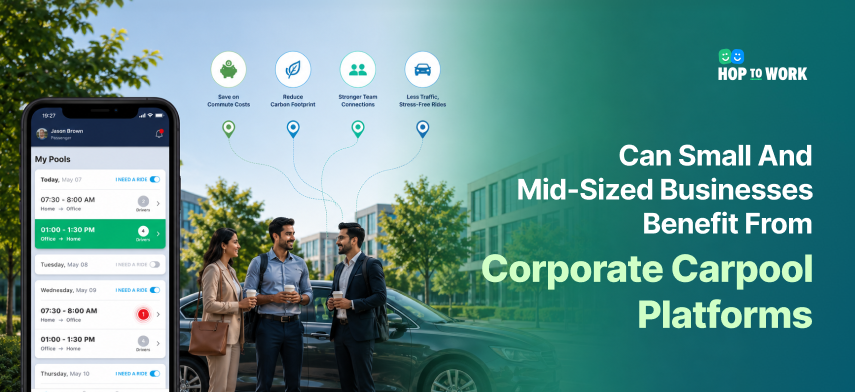
Most small business owners hear "corporate carpooling" and immediately picture a 2,000-person tech campus with a dedicated mobility team and an enterprise software budget.
The assumption that employee carpooling requires massive scale is a holdover from a different era entirely. Back when HR coordinators matched employees using printed maps and phone calls, yes, you needed a large workforce to justify the effort. That era is over. A corporate carpool platform for small businesses today runs residential cluster analysis automatically, produces AI-matched pairs in seconds, and measures CO2 savings per trip. The question is no longer "are we big enough?" It is "do enough of our employees live close enough to each other?"
That is a geography question. Not a headcount question.
This guide is for HR managers, operations leads, and founders at companies with 30 to 1,500 employees who want straight answers. What does workplace carpooling actually cost? What does it deliver? And how do you launch it without an IT department or an enterprise budget?
The Myth That Has Been Costing SMBs Real Money
Here is what the myth gets wrong. Early corporate carpooling programmes were entirely manual. An HR coordinator would collect employee home addresses, eyeball a printed map, identify rough geographic clusters, and match employees over the phone. At that level of effort, you genuinely needed 500 or more employees to make the coordinator's time worthwhile.
Platform-era carpooling removed that bottleneck completely.
A corporate carpool platform for small businesses now handles matching automatically using spatial clustering on anonymised postcode data. It sends push notifications to both the driver and passenger. It can track the journey in real time. It also logs the CO2 saving per trip, per vehicle class, per employee.
None of that requires 500 employees. It requires enough employees living in geographic proximity to each other and the office. That threshold is far lower than most SMB leaders assume.
The Actual Viability Thresholds by Company Size
So what does "viable" actually look like at different sizes? Here is how the numbers break down.
-
30 to 60 Employees
This range is viable, but requires a careful cold-start strategy. The primary condition is that at least 50 to 60 percent of employees live within 25km of each other and the office. You will also need five to eight volunteer drivers to seed the network before passenger invitations go out.
Realistic adoption sits between 20 and 40 percent of eligible employees. That means six to twenty-four active carpoolers. The ESG impact at this size is modest but real, and the benefit per participating employee is disproportionately high.
-
60 to 150 Employees
This is the sweet spot for SMB carpooling. Employee residential patterns typically fall into two to four geographic clusters within a 30km radius. With ten to twenty volunteer drivers confirmed before launch, adoption between 40 and 60 percent is consistently achievable.
At 60 employees, 40 percent adoption means twenty-four active carpoolers. At 150 employees with the same adoption rate, that is sixty people whose commute costs drop meaningfully every month.
-
150 to 500 Employees
Strong viability across the board. Matching density becomes largely self-sustaining on primary routes. Programme management requires roughly half to one full-time-equivalent hour per week, but the return on that time is significant.
Expect 50 to 65 percent adoption. Parking demand reduction is noticeable and quantifiable. ESG data becomes reportable for B Corp or investor communications at this stage.
-
500 to 1,500 Employees
This is a full mid-market territory. All six matching dimensions of the algorithm come into play. CSRD reporting obligations are likely for EU-based companies in this band.
Sustained adoption sits between 55 and 70 percent, approaching enterprise programme performance without the enterprise implementation complexity.
Why the Cold-Start Problem Is Solvable at Small Scale
The cold-start problem in employee carpooling is the classic chicken-and-egg situation. Passengers will not register if there are no drivers. Drivers are reluctant to commit if there are no passengers. At a small scale, the matching pool is thinner, so this tension is sharper.
But here is the thing: the cold-start is actually more solvable at a small scale than at a large scale, for three specific reasons.
-
Small Companies Have a Built-In Social Advantage
Social network seeding works better when everyone knows each other. In a 50-person company, the HR manager probably knows most employees personally. A direct conversation, "you live near three of our marketing team, would you be willing to be one of our founding drivers?", converts at a rate no mass email campaign at a 5,000-person company can touch. The social density of a small company is a cold-start asset.
-
Remove the Risk Before It Stops People from Signing Up
The guaranteed transport fallback removes the biggest barrier. The fear that stops hesitant employees from registering is: "what if there is no match for me?" At a small scale, that fear is valid because the network genuinely is thinner early on. A guaranteed transport fallback, where a taxi credit is automatically applied if no match is available or if a match cancels, removes that fear precisely when it matters most. Fallback activation rates typically run at five to ten percent in month one and drop to one to two percent by month three as density increases.
-
Start with One Route, Then Expand
A route-first launch concentrates early success. Do not attempt to launch workplace carpooling for all employees at once. Identify the single residential cluster with the highest employee density and launch exclusively on that route. Once that route exceeds a 70 percent match rate, usually within four to eight weeks, open the second cluster. Thin simultaneous launches across all routes produce worse early experiences than focused sequential seeding.
The Five Benefits That Matter Most for SMBs
Large enterprises adopt corporate carpooling primarily for CSRD compliance, parking infrastructure savings, and competitive talent positioning. SMBs feel the same pressures, but the priority order is different. Here is how the five core benefits rank for smaller organisations.
Talent Attraction and Retention
In competitive hiring markets, SMBs systematically lose candidates to larger employers on salary and benefits. Corporate carpooling is one of the few benefits where a smaller employer can offer something many large employers do not: a personalised commute with a known colleague, not an anonymous shuttle or a basic parking subsidy.
Three mechanisms explain the talent value:
-
Effective Compensation Increase
The average employee at a UK company with a 20km commute spends roughly £3,400 per year on fuel and parking. A corporate carpool platform for small businesses that reduces that to £1,600 per year delivers an £1,800 annual saving. That is a £150-per-month effective pay rise, without the employer paying a salary premium directly.
-
Sustainability Alignment
A measurable, employee-visible CO2 impact carries more weight with candidates in their 20s and 30s than a sustainability policy page on a website. According to a 2024 Deloitte Global Millennial and Gen Z Survey, over 50% of younger workers factor in a company's environmental record when evaluating job offers. A carpool app for employees that shows each person their personal CO2 reduction after every trip is a more credible sustainability signal than any policy document.
-
Social Connection
Regular carpooling with colleagues builds informal relationships across departments. At an SMB where team culture is a primary competitive asset, that social dividend is worth more than it is at a company of several thousand people.
Employee Cost Savings
The financial benefit to employees varies significantly by commute profile. Here is what the numbers can look like across four common scenarios.
| Commute Profile | Annual Solo Cost | Annual Carpool Cost | Employee Saving |
|---|---|---|---|
| City office, 20km (petrol) | £3,400 | £1,600 | £1,800/year |
| Suburban office, 30km (petrol) | £5,100 | £1,800 | £3,300/year |
| City office, 15km (mixed fuel/EV) | £2,200 | £1,100 | £1,100/year |
| Industrial site, 35km (diesel) | £6,800 | £2,000 | £4,800/year |
ESG and Sustainability Reporting
ESG reporting used to be the exclusive concern of listed companies and large enterprises. That is changing fast, driven by three specific pressures that are increasingly relevant to SMBs.
-
Supply Chain CSRD Requirements
Large enterprise customers with CSRD reporting obligations are asking their suppliers to provide emissions data. A 200-person manufacturing supplier with a major enterprise customer may have a de facto Scope 3 reporting obligation even if they sit below the formal regulatory threshold. GPS-measured Scope 3 Category 7 data from a carpool management software platform provides exactly the verifiable figures these supply chain questionnaires require.
-
B Corp Certification
B Corp's Environment assessment explicitly scores employee commuting impact. GPS-measured CO2 data is weighted more heavily than self-reported estimates. The right employee carpool software formats this data for direct B Corp assessment input.
-
Green Finance
SMBs accessing green loans or sustainability-linked credit increasingly need evidence of genuine sustainability performance, not just policy commitments. GPS-confirmed CO2 reduction data support green finance applications in a way that estimates do not.
-
Parking Cost and Infrastructure Relief
Where parking pressure exists at SMB locations, it is often acute.
A 150-person company in a city-centre office paying £2,000 per year per parking space for 40 spaces is spending £80,000 annually on parking. A corporate carpool platform for small businesses that reduces demand by 25 percent, freeing up ten spaces, and saves £20,000 per year. That figure alone typically exceeds the total platform cost for a company of that size.
At suburban business parks where parking ratios are being tightened to meet planning conditions, employee transportation solutions like carpooling solve a daily logistical problem for employees, not just a financial one.
Expansion-stage businesses facing the ceiling of their current premises will also find that reducing per-employee parking demand buys a meaningful runway before a costly move.
-
Employer Duty of Care
This one is less discussed but genuinely important for smaller organisations. A 60-person company that encourages employees to share lifts informally, or maintains a WhatsApp group for ride-sharing, may have assumed a duty of care obligation without the safety infrastructure to discharge it. A proper corporate carpool app converts informal transport arrangements into a managed, accountable programme.
The safety infrastructure this provides includes government API-verified driver identity and licence checks, GPS tracking throughout every trip, an offline-capable SOS button for both drivers and passengers, incident documentation with timestamps and GPS coordinates, and insurance clarity requiring all drivers to hold appropriate passenger-carrying cover.
An informal arrangement has none of this. The duty of care obligation exists regardless of company size.
What It Actually Costs to Run a Carpool Programme at SMB Scale
The total cost has four components. Understanding each one separately helps HR managers build an accurate business case rather than guessing at a number.
The Four Cost Components
-
Platform Subscription
Most platforms charge per active user per month, where "active" means the employee took at least one trip that month. The starter tier often runs at £12 to £18 per active user, with a minimum of ten users. Per-active-user pricing means quiet months cost less automatically.
-
Employer Subsidy Per Trip
This is optional, but meaningfully accelerates adoption. A subsidy of £0.75 to £1.50 per trip signals employer commitment and reduces the cost barrier for employees. At ten trips per user per month with 40 active users, a £1.00 subsidy adds £400 per month to programme cost. Zero-subsidy programmes are viable but take longer to reach target adoption.
-
Programme Management Time
A well-designed carpool management software platform requires roughly 0.5 to 1.5 FTE-hours per week for programmes up to 200 employees. At a typical HR salary cost, that is £200 to £600 per month. After the first 90 days, the programme largely manages itself.
For example, with HopToWork, SMB onboarding is included in the subscription. There is no external consultant required for standard deployments.
A Full Cost Example: 120-Employee Technology Company
Here is what the estimates look like for a real-world SMB scenario with 120 employees, hybrid working three days per week, 40 active carpoolers per month, and a £1.00 per trip employer subsidy.
Monthly costs:
- Platform: 40 users × £16 = £640
- Subsidies: 40 users × 10 trips × £1.00 = £400
- Programme management: 1 hour/week × 4 weeks × £25/hour = £100
- Total: £1,140 per month (£13,680 per year)
Conservative Monthly Benefits:
- Parking saving: 15 fewer cars × £100/space = £1,500
- Employee fuel saving: 30 passengers × £95/month average = £2,850
- CO2 ESG value: 40 employees × 3.2 tonnes × £50/tonne ÷ 12 = £533
- Recruitment cost saving from reduced attrition: £417
- Total: £5,300 per month (£63,600 per year)
Net annual benefit: £49,920. ROI: 365%.
These figures use industry benchmark estimates. Parking saving depends on your actual space cost. Retention saving depends on your actual attrition rate and replacement cost. Verify with your own data before presenting to leadership.
How to Launch Without an IT Department
The most common reason HR managers at SMBs do not launch employee commute solutions is not that they cannot see the value. It is that they assume the launch requires technical resources they do not have.
A proper corporate carpool platform for small businesses is designed to be launched by an HR manager or office manager with no technical background, in under a week, using a spreadsheet and a browser. Here is how that week actually looks.
The Week-One Launch Checklist
-
Day One (morning)
Create the organisation account. Set the programme name and configure the subsidy amount (can be £0). Upload the employee roster as a CSV file, which any spreadsheet can export in one click. This takes about 45 minutes.
-
Day One (afternoon)
Identify eight to fifteen founding drivers. Review where employees live and approach the most geographically clustered ones personally or by email. Personal conversations work better at a small scale than any template. Allow 60 to 90 minutes for this step.
-
Days Two and Three
Founding drivers download the app and complete their profile. Each driver needs ten minutes, a smartphone, a driving licence, and vehicle registration. Platform licence verification runs automatically via a government API call. HR monitors completion and follows up with anyone who has not finished by day three.
-
Day Four
Send the all-employee invitation. The platform provides a launch email template that explains what employee carpooling is, how to sign up, and what the guaranteed transport fallback covers. A personal note from the CEO or HR director sent alongside this email meaningfully improves registration rates.
-
Days Five to Seven
First matches begin. The HR manager reviews the admin panel for any flagged matches before they happen. A personal follow-up to anyone who registered but has not requested a match by day seven captures the hesitant registrants who need one more nudge.
-
Weeks Two to Four
One hour per week reviewing seven programme health metrics: match rate, first-match satisfaction score, registration rate, driver-to-passenger ratio, and related indicators. The platform sends a weekly digest automatically.
No SSO configuration. No HRMS integration. No enterprise procurement process. The admin panel runs in any browser.
The Three Most Common SMB Launch Mistakes
Several mistakes lead to carpool platform launch failures for SMBs. Among those, the below three are most common.
Launching Before Enough Drivers Are Ready
This is the most common mistake. The all-employee invitation goes out before a sufficient driver base is in place. Passengers register, request matches, receive a "no match available" response, and conclude that the platform does not work.
The rule is straightforward: do not send the all-employee invitation until at least 10 to 15 percent of eligible employees have registered as drivers and completed their profiles. For a 100-person company, that means ten to fifteen confirmed drivers before a single passenger invitation is sent.
Burying the Fallback Guarantee
Many employees who do not register are not opposed to carpooling. They are worried about being stranded. If the launch email does not prominently mention the guaranteed transport fallback in the first paragraph, a significant portion of cautious employees will not sign up.
The guaranteed fallback should be in the subject line or the opening sentence, not three scrolls down in a FAQ.
Treating Launch as a One-Time Event
The most sustainable workplace carpooling programmes treat the first twelve weeks as an active management period, not a deployment date.
The activities that matter most in weeks one to six are personal first-match curation, a follow-up message within 24 hours of every employee's first trip, and identifying two to three enthusiastic early users to reach out personally to colleagues who registered but have not yet taken a trip. Champion advocacy at the SMB scale is far more effective than any automated re-engagement sequence.
Which Types of SMBs Benefit Most
Not every SMB is equally well-positioned for employee transportation solutions. The benefit depends on three factors: residential geography, workforce characteristics, and the organisation's strategic priorities.
Technology Startups and Scale-Ups (50 to 300 Employees)
Primary benefit driver: talent attraction and sustainability credentials.
Tech employees tend to live in urban residential clusters near tech hubs. Hybrid working creates predictable office-day schedules that pair well with regular employee carpooling. The culture in most tech companies is receptive to app-based coordination.
The ROI here comes primarily from reduced recruitment agency fees, lower employee churn, and a B Corp or sustainability credential that supports the commercial pipeline.
Healthcare Clinics and Allied Health Practices (60 to 250 Employees)
Primary benefit driver: parking relief and staff retention.
Parking at healthcare facilities is frequently constrained. Staff turnover in healthcare is high and expensive, with replacement costs running from £5,000 to £15,000 per employee, depending on the role.
Shift-based working requires a shift-aware matching configuration. Evening and night shift patterns make women's safety features particularly relevant in this sector.
Logistics and Distribution SMEs (50 to 400 Employees)
Primary benefit driver: employee transport cost and supply chain ESG.
Warehouse staff typically face long commutes to out-of-town distribution centres. Vehicle access in warehouse workforces is generally high. Residential catchments for distribution centre locations tend to be geographically concentrated, which supports matching density.
Supply chain ESG requirements from large customers are expanding fastest in this sector. GPS-measured Scope 3 Category 7 data from a corporate carpool platform for small businesses directly answers those questionnaires.
Professional Services Firms (30 to 200 Employees)
Primary benefit driver: parking cost and talent differentiation.
City-centre parking is among the most expensive recurring costs for professional services businesses. A 150-person firm with 40 parking spaces paying £2,000 per space per year is spending £80,000 annually just on parking.
Professional services employees typically work regular office hours from defined commuter corridors, which is an ideal profile for reliable matching on a corporate carpool app.
Manufacturing SMEs (100 to 500 Employees)
Primary benefit driver: employee transport cost and supply chain ESG.
Manufacturing workers at suburban or semi-rural factory sites often face the longest commutes in the SMB landscape. The employee cost saving of up to £4,800 per year for a long-commute manufacturing worker is the highest of any sector profile.
Large manufacturer customers are extending Scope 3 reporting requirements to their suppliers. A verifiable CO2 reduction from a business carpool solution directly addresses those requirements.
B Corp and Purpose-Led SMBs (Any Size, Any Sector)
Primary benefit driver: sustainability credentials and employee values alignment.
B Corp employees are self-selected for sustainability motivation. Adoption in purpose-led companies consistently exceeds industry averages. The carpool app for employees becomes a daily visible expression of company values, not just a benefit on a list.
B Corp's Environment assessment explicitly scores employee commuting impact, and GPS-measured CO2 data is weighted more heavily than self-reported estimates in the assessment process.
ESG and Sustainability: Why the Pressure Is Coming for SMBs
SMBs have historically operated outside formal ESG reporting requirements. That is changing, driven by three forces that are accelerating specifically in 2026.
Supply Chain CSRD Requirements
Large enterprises subject to CSRD must disclose Scope 3 Category 14 data and are increasingly pressing their suppliers to provide their own emissions figures. Some procurement qualification processes now require supplier ESG data as a formal criterion.
A 200-person manufacturing or logistics SMB with a major enterprise customer may face a de facto CSRD obligation well before the formal regulatory threshold reaches their company size. GPS-confirmed trip data from a corporate commute management solution provides exactly the verifiable figure these questionnaires require.
B Corp Certification
The B Corp Environment assessment explicitly includes employee commuting impact. Estimated data from postcode centroids is acceptable for general stakeholder communication, but is not sufficient for B Corp assessment. GPS-measured CO2 data satisfy B Corp's evidence requirements.
Employee transportation solutions that provide per-employee CO2 saving data, formatted specifically for B Corp input, remove the friction from this part of the certification process.
Green Finance and Lending
SMBs accessing green bonds, sustainability-linked loans, or government green finance schemes increasingly need documented evidence of genuine sustainability performance. Policy commitments without supporting data are no longer sufficient for most green lending criteria.
An annual CO2 reduction report with GPS confirmation provides the evidence that green lenders require. This is a tangible differentiator for SMBs seeking green finance in 2026.
Mandatory CSRD: The Timeline That Matters
The mandatory CSRD reporting timeline is worth knowing, regardless of the company's current size. EU-based companies with over 250 employees face reporting requirements from the 2026 reporting year. The scope is expected to extend to smaller companies in subsequent years.
UK equivalents are developing under separate disclosure requirements. Companies approaching the threshold that build GPS-measured Scope 3 Category 7 data infrastructure now will be ahead of the compliance curve when the obligation formally arrives.
The ESG Data Quality Hierarchy
Not all CO2 data is equal, and the quality of the data determines how credibly sustainability claims can be communicated externally.
-
Estimated Data Works Internally, Not Externally
Estimated data from postcode centroids is suitable for internal tracking and general stakeholder communications. It is not appropriate for B Corp assessment, green finance applications, or any external ESG audit. The aggregate number is approximately right, but cannot be verified at the individual trip level.
-
GPS-Measured Data Is What External Auditors Actually Accept
GPS-measured data is suitable for B Corp assessment, supply chain ESG questionnaires, green finance applications, and any external sustainability communication where credibility matters. The figure is GPS-confirmed and auditable at the trip level.
-
ESRS E1 Documentation Prepares You for What Is Coming
GPS-measured data with ESRS E1 methodology documentation is required for CSRD compliance. It is also valuable for any SMB that wants its ESG data to be audit-ready for future requirements. The right employee carpool platform includes this methodology documentation in all deployments, not as an enterprise add-on.
Adoption at SMB Scale: What Makes It Different
Corporate carpooling adoption at the SMB scale is both harder and easier than at the enterprise scale.
Harder because the matching pool is thinner, the cold-start problem is more acute, and reputation effects spread faster. In a 50-person company where five employees have a bad first-match experience and mention it to colleagues, that is ten percent of the entire workforce hearing a negative story.
Easier because the HR manager knows most employees personally, social proof spreads in real time, and a personal conversation from the CEO carries weight that an all-company email at a 5,000-person business cannot replicate.
How SMB Adoption Compares to Enterprise
| Adoption Factor | Enterprise | SMB | SMB Advantage? |
|---|---|---|---|
| Social network density | Employees know a small fraction of colleagues | Employees know 30 to 70 percent of their colleagues | Yes |
| CEO or leader endorsement | Low incremental impact from all-company email | Founder participation is a powerful personal signal | Yes |
| Cold-start severity | A large network creates driver density naturally | Thin matching pool requires active early management | Challenge |
| Champion advocacy reach | Champions reach immediate teams only | Two or three champions can reach 30 to 50 percent of the company | Yes |
| Match quality consequences | Poor match diluted by thousands of successes | A poor match may be discussed by three colleagues at lunch | Challenge |
The SMB Champion Activation Strategy
At the SMB scale, the champion network outperforms every other adoption tool available. More powerful than incentive programmes, platform features, and any re-engagement sequence.
Here is how to run it.
-
Identify Two To Four Founding Champions
Look for employees who are early tech adopters, hold a positive attitude toward sustainability, commute from a residential area with several colleagues, and are genuinely liked across departments. Peer-level champions who are seen as "one of us" consistently outperform manager-level endorsers.
-
Brief Champions On The Honest Reality
The first few weeks may have thin matching while the network builds. The guaranteed transport fallback exists for occasions when no match is available. The CO2 impact is real and measurable. Arming champions with honest answers to the three questions they will face, "what if my match cancels, what if I do not like who I am matched with, does it actually save me money," produces more credible advocacy than polished talking points.
-
Give Champions Specific Outreach Tasks
Provide each champion with a list of five to eight employees who registered but have not yet taken a trip. Ask them to reach out personally with a concrete offer: "I am carpooling on Wednesday; do you want to try it together?" A personal invitation from a trusted colleague to share a specific trip converts at four to six times the rate of any automated re-engagement message.
-
Celebrate Champion Contributions Publicly
At a company all-hands or team meeting, name the champions and share the programme's CO2 impact and participant count. In a small company, public recognition carries real weight. Champions who are recognised publicly are more likely to sustain their advocacy beyond the first month.
What HopToWork Actually Gives SMBs
The HopToWork Starter tier is not a cut-down version of an enterprise product. It is the same matching algorithm, the same safety architecture, and the same GPS-measured ESG reporting, with the enterprise IT complexity removed entirely.
No SSO configuration. No HRMS integration. No WFM system. A CSV upload, an OAuth login, and a three-to-five-day setup.
For SMBs looking at custom-built options, Rideshare and Carpooling App Development is an avenue worth exploring for businesses with more complex or sector-specific requirements.
What Is Included in the SMB Starter Tier
Employee Onboarding
- CSV upload and batch email invitation
- Individual self-registration via link
- One-click Google or Microsoft 365 OAuth login
- No password management required
AI Matching
- Six-dimensional algorithm covering:
- Schedule compatibility
- Route geometry
- Preference compatibility
- Match history
- Workplace proximity
- Reliability score
- Calendar integration with Google Calendar and Microsoft 365 included
Passenger Experience
- iOS and Android apps with live driver tracking
- Driver photo and vehicle registration displayed in-app
- One-tap in-app messaging and full trip history
- Personal ESG impact dashboard for every user
Safety Stack (Full, Not Reduced)
- Government API driver identity and licence verification
- Accredited criminal background check
- Real-time GPS tracking with route deviation detection and three-level escalation
- Offline-capable SOS with SMS fallback and passenger-only dismissal
- Four automatic safety triggers:
- Silence detection
- Sudden stop
- Extended journey time
- Post-trip GPS discrepancy
- Guardian tracking link for personal contacts
ESG Reporting
- GPS-measured CO2 per trip with per-vehicle-class DEFRA and EPA emission factors
- Monthly ESG summary and shareable employee impact cards
- B Corp-ready data format included as standard
Adoption Programme
- Calendar integration for proactive match suggestions
- First-match curation tools for the HR manager
- Guaranteed transport fallback engine
- Configurable incentive engine with milestone rewards and peer referral
- CO2 leaderboard and automated dropout re-engagement at day fourteen and day thirty
- Seven programme health metrics with weekly digest email
Employer Admin Portal
- Employee roster management and programme configuration
- Adoption analytics, safety log, and subsidy budget tracking
- Monthly programme health summary
- Runs in any browser with no software installation required
For SMBs exploring the broader category of Carpooling App Development or deployment, the feature architecture above gives a useful baseline for what a production-grade platform requires.
When to Move from Starter to Professional Tier
The Starter tier is appropriate for most SMBs at launch and through the first twelve to eighteen months. Four conditions typically signal that a move to Professional is warranted.
The programme has over 150 active users, and programme management time regularly exceeds two hours per week. The Professional tier's manager activation module and team challenge console automate the department-level outreach that becomes the primary time consumer at this scale.
The organisation has a formal CSRD reporting obligation or an ESG auditor requiring the full methodology document. The Professional tier includes the CSRD auditor data export with signed attestation and the ESRS E1 methodology document with uncertainty quantification.
The company has implemented SSO via Microsoft Entra or Google Workspace and wants to extend single sign-on to the carpooling platform.
The organisation has grown to 300 or more employees, or has opened a second office location requiring dual-site matching pool configuration.
Honest Answers to the Most Common SMB Objections
HR managers and business owners raise predictable objections when evaluating corporate carpooling. Addressing these honestly matters more than selling around them.
-
"We Are Too Small for Carpooling to Work"
This is sometimes true. A 20-person company in a rural area where employees commute from different towns may not have the residential density for reliable matching.
The correct answer requires running a residential cluster analysis on anonymised postcode data, not assuming a conclusion. If the analysis shows five or more employees within carpooling distance in at least one cluster, a programme is worth trying. The three-to-five-day setup and per-active-user pricing mean the risk of a low-adoption outcome is a few months of modest cost, not a failed capital project.
-
"Our Employees Need Flexibility and Will Not Carpool"
This is a real constraint for employees who regularly need their car for client visits, school pickups, or unpredictable finish times.
Workplace carpooling works best as a benefit for the subset of employees whose schedule is predictable enough for regular matching. Even if only 30 percent of employees qualify, a 30-person carpooling pool at a 100-person company still produces meaningful parking savings, a reportable ESG metric, and a valued benefit for those employees. Not everyone needs to participate for the programme to deliver value.
-
"We Tried a WhatsApp Group and It Did Not Work"
This is a completely accurate description of what unmanaged carpooling looks like without a platform.
The WhatsApp group failed because it put every coordination burden on the participants. No matching algorithm. No safety infrastructure. No fallback for cancelled trips. The right corporate commute management solution removes every one of those failure modes by design.
-
"Privacy Concerns Make This Complicated"
There are genuine privacy considerations. Employees must consent to GPS tracking during trips, and home addresses are used for matching. These require thoughtful communication.
A GDPR-compliant employee privacy notice is included in the programme launch communications. GPS tracking is active only during programme trips. Employees can opt out at any time. Consent is built into the platform's onboarding flow, not handled separately.
-
"The Cost Is Hard to Justify Right Now"
At £640 per month for 40 active users, the platform cost is a real expenditure. If parking savings and employee retention benefits are not meaningfully present in your specific context, the ROI case is weaker.
Build the business case with your specific numbers: your actual parking space cost, attrition rate and replacement cost, and realistic adoption estimate. For most SMBs in urban or suburban locations, the benefit exceeds the cost by a significant multiple. If it does not work in your context, carpooling may not be the right employee commute solution for you right now, and that is a valid conclusion.
The Pre-Launch Decision Checklist
The decision to launch employee transportation software at the SMB scale does not require six months of analysis. It requires answering six questions honestly, running a residential cluster check, and committing to 90 days of active programme management.
If you can answer yes to four or more of the six questions below, your organisation is ready to launch.
Six Pre-Launch Questions
-
Do at least 30 percent of your employees live within 25km of each other and your office?
This is the primary viability condition. Without residential proximity, matching density will be insufficient for reliable employee carpooling regardless of any other factor. A rough look at where employees live by postcode area is enough for a first assessment.
-
Can you identify five to eight employees with regular, predictable commuting schedules?
These are your founding drivers. If you can name five potential founding drivers before launch, the cold-start is manageable. If you cannot, the programme is not yet viable.
-
Is commute cost or convenience a visible concern among your employees?
If employees have mentioned parking cost, fuel cost, or commute difficulty in any staff survey, exit interview, or casual conversation with HR, employee demand exists. Without demand, adoption will be low regardless of how good the platform is.
-
Does your organisation have any sustainability commitment, even informal?
A net-zero pledge, a sustainability page on the company website, or an expressed interest in B Corp certification all signal the presence of sustainability-motivated early adopters. These are the highest-converting users in the first month.
-
Can one HR manager commit one to two hours per week to programme management for the first 90 days?
Active management in the first 90 days is the difference between a programme that reaches critical mass and one that plateaus below viability. The carpool app for business reduces this to one to two hours per week but does not eliminate it entirely.
-
Is the platform cost within a reasonable benefits budget for your size of company?
For a 120-person company, the total programme cost runs to approximately £1,140 per month. For most SMBs, this is comparable to a company social event per quarter. The ROI is strongly positive in most urban and suburban contexts, but the budget must exist to get started.
The Three Decision Paths
-
Five To Six Yes Answers
Launch now. Request a residential cluster analysis from HopToWork, which requires no commercial commitment and is completed in five to seven business days from postcode data submission. If the analysis confirms viable matching density, proceed to the five-day launch. Commit to a 90-day active management period before evaluating adoption outcomes.
-
Three To Four Yes Answers
Launch with lower expectations and a longer timeline. A programme with moderate employee demand, limited geographic clustering, or constrained HR management time can still work. Expect six to twelve months to reach stable adoption rather than three months, with an adoption ceiling of 30 to 40 percent rather than 55 to 65 percent.
-
Zero To Two Yes Answers
Revisit in twelve months. A company where employees live far apart, have highly variable schedules, are not particularly concerned about commuting, and has no sustainability interest or programme management capacity is not ready for employee carpooling at this stage. That does not mean carpooling will never be right for this company. It means the timing is not right now.
The Bottom Line
The question this guide opened with, "can small and mid-sized businesses benefit from a corporate carpool platform for small business," has a clear answer. Yes, if the residential geography supports viable matching density. And for most SMBs in urban and suburban locations, it does.
The five benefits are real and, in several cases, proportionally larger per employee at the SMB scale than at the enterprise scale. The employee cost saving matters more to employees in lower salary bands. The sustainability credential differentiates more for SMBs competing against larger employers on brand. The social connection benefit carries more weight at a company where team culture is one of the few competitive assets a smaller organisation holds over a large one.
The barrier to starting is genuinely low. Three to five business days. One CSV file. No IT department. No enterprise procurement process. One HR manager spends one to two hours per week for the first 90 days. And a platform that delivers the matching algorithm, safety infrastructure, ESG reporting, and adoption programme architecture that would cost many times more to build from scratch.
For most SMBs in locations where employees live within reasonable carpooling distance of each other, the question is not really whether corporate carpooling works at your scale. The question is whether you are ready to find out.
Frequently Asked Questions
Can a small business with 50 employees benefit from a corporate carpool platform?
Yes, if at least 15 to 25 employees live within 25km of each other in geographic clusters. Realistic adoption sits between 20 and 40 percent of eligible employees. Benefits include parking savings, employee cost reductions of £1,100 to £2,000 per year, and a tangible ESG metric for B Corp or client questionnaires.
What is the minimum employee count for corporate carpooling to work?
There is no universal minimum. The threshold depends on residential geography, not headcount. Run a residential cluster analysis on anonymised postcode data and if one cluster has ten or more employees within carpooling distance, a programme is viable.
What does a corporate carpool platform cost for a small business?
The Starter tier often runs at around £12 to £18 per active user per month. For a 120-person company with 40 active users, the total programme cost sits at approximately £1,140 per month. Conservative ROI from parking savings and retention typically exceeds that cost by three to five times.
What ESG reporting does a small business get from a carpool platform?
GPS-measured CO2 data per trip is available in the Starter tier, not just enterprise deployments. Monthly outputs include employee-level impact data and a programme ESG summary suitable for B Corp assessment or supply chain questionnaires.
How does corporate carpooling help SMB talent attraction and retention?
Employees save approximately £1,100 to £2,000 per year on fuel and parking, which functions as an effective monthly pay rise without a direct salary cost. Regular carpooling also builds cross-team relationships that reduce voluntary attrition from poor team dynamics.
How does an SMB launch a carpool programme without an IT department?
HopToWork onboarding takes three to five business days and requires only a CSV roster, a browser, and an HR manager with a few hours to spare. No SSO, no HRMS integration, and no IT involvement at any stage.


Nitin Lahoti is the Co-Founder and Director at Mobisoft Infotech. He has 15 years of experience in Design, Business Development and Startups.