
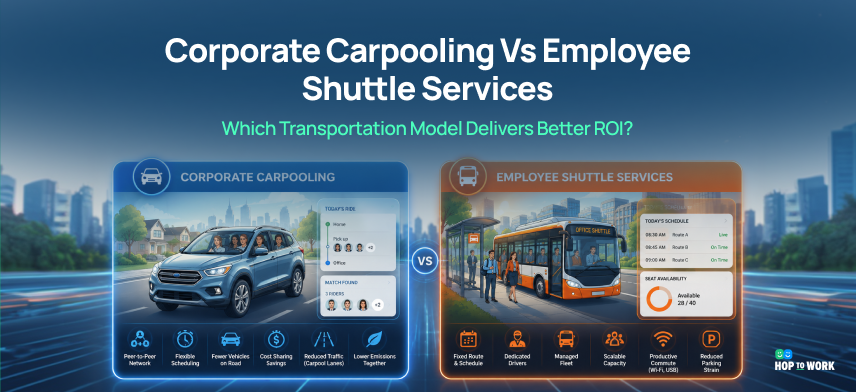
The decision between corporate carpooling vs employee shuttle services is not primarily a technology decision. It is an operations design decision that determines how your organisation thinks about corporate employee transport solutions: as a scheduled logistics operation with fixed routes and fixed costs, or as a flexible, demand-responsive service that scales with actual employee attendance.
Both models have genuine strengths and limitations. The ROI calculation for employee transport cost comparison involves indirect benefits as well. This includes parking demand reduction, talent attraction, and employee punctuality that affect the bottom line in ways that do not appear on the transport budget line item. This guide provides the framework, the numbers, and the decision criteria that HR directors, CFOs, and facilities managers need to choose the model that fits their organisation.
Defining the Two Models: What Corporate Carpooling and Employee Shuttles Actually Are
Before comparing ROI, it is necessary to define what each model actually involves, because both terms cover a wide range of implementations with materially different cost structures, technology requirements, and operational complexity.
What Corporate Carpooling Actually Involves
Corporate carpooling exists at several implementation levels, each with a different cost and operational profile.
-
Informal Carpooling
Employees self-organise rides with colleagues. The employer plays no role beyond encouragement. There is no subsidy, no tracking, and no safety infrastructure. Direct cost to the employer is near zero. This model is only suitable for very small teams where all employees know each other. It is not recommended for any organisation with duty of care obligations.
-
Platform-Managed Carpooling (Basic)
A third-party SaaS platform manages matching. The employer pays a platform fee. Basic GPS tracking, driver verification, and passenger safety features are included. Cost typically runs USD 50 to 200 per employee per year, covering the platform fee only. This level works for offices of 50 to 500 employees, organisations starting a carpooling programme, and hybrid working environments.
-
Platform-Managed Carpooling (Enterprise)
This tier uses a custom or enterprise-grade corporate carpooling platform with AI matching, calendar integration, an employer admin portal with ESG reporting, employer subsidy per trip, and a full safety architecture covering SOS, deviation detection, and a women's safety protocol. Cost runs USD 380 to USD 950 per employee per year. This level is suited to campuses of 500 to 10,000 or more employees, organisations with active ESG reporting obligations, and large suburban or peri-urban campuses with parking pressure.
-
Custom Proprietary Carpooling Platform
The employer builds and operates its own carpooling matching engine with full data ownership, proprietary AI, a custom ESG methodology, and integration with HRMS and benefits platforms. Amortised development and operations costs run USD 1,000 to 2,500 per employee per year. This level is justified only for very large organisations of 10,000 or more employees, or those with platform-as-product ambitions.
What Employee Shuttle Services Actually Involve
Employee shuttle services similarly span a range from basic contracted transport to sophisticated demand-responsive operations.
-
Fixed-Route Minibus (Basic)
A contracted minibus operates on one or two fixed routes, runs on a fixed schedule, and requires no booking. Cost runs USD 800 to 1,200 per employee per year on served routes. This model works well for manufacturing, warehousing, and industrial sites with concentrated residential catchments and predictable shift patterns.
-
Multi-Route Shuttle Programme
Several routes cover different residential zones. Booking or reserved seating is optional. The fleet runs two to ten vehicles with fleet management software. Cost ranges from USD 1,200 to 2,000 per employee per year, depending on route length and vehicle type. This suits large suburban office campuses, tech campuses, universities, and hospitals. This is the standard tier for a corporate shuttle service in a mid-to-large employer context.
-
Premium Shuttle Service
High-specification coaches with Wi-Fi, individual seating, and phone charging operate with a booking app, real-time tracking, route optimisation, and a dedicated fleet manager. Cost runs USD 2,500 to USD 3,800 per employee per year. This tier targets large tech employer campuses of 500 to 3,000 employees where talent attraction is a primary programme objective.
-
Demand-Responsive Shuttle
The vehicle goes where demand is, not on a fixed route. A dynamic routing algorithm determines stops based on that day's bookings via real-time booking. Cost runs USD 1,500 to 2,500 per employee per year. This model suits organisations with moderate route diversity and variable daily attendance. It is a hybrid of shuttle economics and carpooling flexibility, but requires significant technology investment.
Cost Comparison: The Full Financial Picture
The most common error in the corporate carpooling vs employee shuttle cost comparison is comparing direct programme costs without accounting for the indirect financial impacts both models create. Direct costs such as vehicles, drivers, platform fees, and subsidies are the visible budget line. Indirect impacts such as parking demand reduction, recruitment value, employee time savings, and punctuality improvement are the real determinants of ROI.
Direct Cost Comparison at Three Scales
| Cost Element | Carpooling (Enterprise) | Fixed-Route Shuttle | Demand-Responsive Shuttle | Notes |
|---|---|---|---|---|
| Platform / software | USD 50–200 / employee / year | USD 150–400 / employee / year | USD 300–600 / employee / year | Fleet mgmt software for shuttle; demand-responsive routing for DRS |
| Vehicle costs (amortised) | None | USD 400–1,000 / employee / year | USD 500–1,200 / employee / year | DRS vehicles typically costlier per seat |
| Driver / operator costs | None | USD 350–900 / employee / year | USD 400–1,000 / employee / year | Professional drivers + dispatcher for DRS |
| Fuel and maintenance | None (covered by passenger contributions) | USD 200–400 / employee / year | USD 250–500 / employee / year | Fixed route achieves better fuel efficiency than DRS |
| Employer subsidy per trip | USD 150–250 / employee / year (optional; ~USD 1–3/trip; 150 trips/year avg) | Included above | Included above | — |
| Operations overhead | USD 30–50 / employee / year | USD 100–300 / employee / year | USD 150–400 / employee / year | DRS has the highest overhead due to dynamic routing complexity |
| Total direct cost | USD 280–650 / employee / year | USD 1,200–3,000 / employee / year | USD 1,600–3,700 / employee / year | — |
| At 500 employees (annual) | USD 150K–375K | USD 600K–1.5M | USD 800K–1.85M | Illustrative; validate with local data |
The Indirect Financial Impacts That Change the ROI Calculation
The four indirect impacts below consistently determine which model produces better ROI for a given organisation.
-
Parking Demand Reduction
Carpooling is strong here: each group of three reduces peak parking demand by two vehicles. Shuttle impact is even greater per USD 3,000 to USD 15,000 per space per year, depending on location. Where parking is a cost or a constraint, this reduction has direct financial value. This is a key component of the employee shuttle service ROI calculation for campus-based employers.
-
Talent Attraction and Retention Value
Carpooling benefit is valued at USD 50 to 200 per employee per year in benefits surveys. Younger employees value the sustainability dimension, not just convenience. Premium shuttle is valued at USD 1,500 to 3,000 per employee per year. Convenience and time productivity are the primary drivers. This impact is difficult to directly monetise but directly affects talent acquisition costs and attrition rates. It is quantifiable in organisations with robust HR analytics.
-
Employee Time Productivity
Carpooling passengers gain commute time for reading, phone calls, or email. Drivers do not. Average passenger gain is around 25 minutes per day. Shuttle passengers gain the full commute time, and a premium shuttle with Wi-Fi enables productive work during the journey. This benefit is most compelling for knowledge workers in a premium shuttle context.
-
Employee Fuel Cost Saving
Carpooling passengers who regularly avoid driving save USD 800 to 1,400 per year. The transport subsidy per trip model in carpooling means employees see a clear out-of-pocket benefit. Shuttle passengers save USD 800 to 1,200 per year. Employee out-of-pocket savings is a recruitment and retention factor, reducing the effective compensation gap versus competitors without a transport benefit.
-
Employee Punctuality
Carpooling with fixed pickup times reduces late arrivals caused by solo commute variability. AI-matched carpooling with 5 to 10 minute schedule flexibility windows may be less precise than the shuttle. Shuttles with a fixed schedule produce highly predictable arrival times and are particularly valuable for shift workers and manufacturing operations where late arrivals cause production disruption.
The ROI Calculation Framework
The figures below illustrate the ROI comparison at a 500-employee office with 60 percent adoption, meaning 300 active participants in each model.
Carpooling ROI (Enterprise Platform, 300 Active Participants)
- Direct programme cost: 300 employees x USD 665 avg = USD 199,500 per year
- Parking demand reduction: 100 fewer vehicles x USD 5,000 per space per year = USD 500,000 value
- Talent attraction and retention saving: 300 employees x USD 800 benefit value = USD 240,000
- Employee fuel saving (retention effect): 200 passengers x USD 1,100 per year = USD 220,000
- CO2 reduction (ESG reporting value): 300 employees x 3.2 tonnes x USD 50 per tonne = USD 48,000
- Total benefit: USD 1,008,000
- Net benefit: USD 1,008,000 minus USD 199,500 = USD 808,500 per year
- ROI: 405% (benefit per USD 1 of cost = USD 5.05)
Fixed-Route Shuttle ROI (3 Routes Serving 300 Participants)
- Direct programme cost: 300 employees x USD 2,100 avg = USD 630,000 per year
- Parking demand reduction: 6 vehicles x 40 employees each x USD 5,000 per space = USD 1,200,000 value
- Talent attraction and retention saving: 300 employees x USD 2,000 benefit value = USD 600,000
- Employee fuel saving: 300 employees x USD 1,000 per year = USD 300,000
- CO2 reduction (ESG value): 300 employees x 2.2 tonnes x USD 50 per tonne = USD 33,000
- Total benefit: USD 2,133,000
- Net benefit: USD 2,133,000 minus USD 630,000 = USD 1,503,000 per year
- ROI: 238% (benefit per USD 1 of cost = USD 3.38)
Both ROI calculations include indirect benefit estimates that require local validation. Parking space value varies from USD 2,000 to USD 15,000 or more per year by location. Talent benefit value requires your own HR analytics data to confirm. Both models produce strongly positive ROI under reasonable assumptions. The shuttle produces a higher absolute benefit but at a much higher direct cost.
ESG and Sustainability Impact: Which Model Reduces Emissions More Effectively?
Both carpooling and shuttle services reduce the number of individual vehicles on the road for employee commutes. This directly lowers the organisation's corporate carbon footprint reduction profile. The question of which model produces greater environmental benefit depends on three variables: load factor, vehicle type, and counterfactual. The answer varies by organisation and implementation.
Emissions Comparison by Scenario
| Scenario | CO2/passenger-km | vs Solo Car | Notes |
|---|---|---|---|
| Solo petrol car (baseline) | ~170g | Baseline (100%) | DEFRA 2025; approx. 3.8 tonnes CO2/yr for 20km each-way commute, 220 days |
| Carpooling (2 occupants, petrol) | ~85g | 50% reduction | Well-matched routes keep detour fuel burn minimal |
| Carpooling (3 occupants, petrol) | ~57g | 66% reduction | Most common enterprise carpool size; strong ESG metric |
| Diesel minibus (30 seats, 75% load) | ~25g | 85% reduction | Fixed-route shuttle at good load factor; excellent per-passenger emissions |
| Diesel minibus (30 seats, 40% load) | ~47g | 72% reduction | Common at non-peak times and low-adoption routes |
| Electric shuttle (30 seats, 75% load) | ~5–12g (grid-dependent) | 93–97% reduction | Best-case outcome; requires charging infrastructure |
| Carpooling (EV driver, 3 occupants) | ~4–10g | 94–98% reduction | EV carpooling at 3 occupants; depends on EV incentive programme |
| Demand-responsive shuttle (12 seats, 85% load) | ~18–28g (diesel) | 83–90% reduction | Dynamic load factor beats large underloaded bus |
ESG Reporting Capability Comparison
The two models differ significantly in how their emissions reductions are reported and verified.
-
Scope 3 Category 7 Measurement
Carpooling produces cleaner Scope 3 Category 7 accounting. GPS-confirmed trip distance per passenger, emission factor by vehicle class per trip, and a methodology aligned with the GHG Protocol Scope 3 Category 7 make the data auditable at the trip level. Shuttle transport is closer to Scope 1 or Scope 3 Category 9, depending on who owns the vehicles. This requires careful methodology documentation and is more complex for employee commute, Scope 3 reporting purposes.
-
CSRD Alignment
Carpooling offers strong CSRD alignment. Per-trip CO2 is calculated from GPS distance and DEFRA or EPA factors. The methodology is documentable, and the trip-level data is auditable. Shuttle service provides moderate alignment: it reduces employee commute emissions by providing an alternative, but the methodology for the Scope 3 reduction credit requires careful documentation.
-
Absolute CO2 Reduction at High Adoption
A well-loaded shuttle at 75 percent or higher reduces per-passenger emissions by 85 percent and is more powerful if universal coverage is achievable. CO2 per passenger kilometre for carpooling at three occupants delivers a 66 percent reduction, but reaching 80 percent adoption or more is very challenging in practice.
-
Adoption Scalability for ESG Targets
Carpooling scales to serve employees across diverse geographies without route infrastructure investment. It scales with demand and can form part of a broader sustainable commuting programme . Shuttle serves defined routes only. Employees outside the route catchment cannot participate, creating a hard ceiling on adoption percentage for geographically dispersed employee populations.
-
Employee EV Incentive Integration
The carpooling platform can add a bonus subsidy per trip for EV-driving carpool drivers, directly incentivising fleet electrification. This EV carpooling incentive programme is a material advantage for organisations with EV fleet transition targets. Employers running shuttles can mandate an EV fleet transition directly, but the capital investment is higher and depends on charging infrastructure.
Employee Experience and Satisfaction: Which Model Do Employees Actually Prefer?
Employee satisfaction with a transport benefit is both a retention factor and an adoption driver. A transport programme that employees find inconvenient or lower-quality than their solo commute will have low adoption regardless of its cost advantage to the employer.
The Employee Value Proposition by Model
| Factor | Carpooling | Fixed-Route Shuttle | Demand-Responsive | Winner |
|---|---|---|---|---|
| Schedule flexibility | High: +/−15 min window; hybrid days accommodated | Low: fixed times; missed shuttle = solo commute | Moderate: adapts to bookings; constrained by capacity | Carpooling |
| Route flexibility | High: near door-to-door pickup | Low: must travel to pickup point (may add 10–20 min) | Moderate: demand-determined pickup points | Carpooling |
| Comfort and privacy | Moderate: depends on co-passengers; social element | High (premium): guaranteed seat; Wi-Fi; no coordination | Moderate: smaller vehicles; more intimate than large coach | Premium shuttle wins; carpooling over basic shuttle |
| Journey time predictability | Moderate: match quality and detours affect time | High: fixed route; professional driver; no detour | Moderate: dynamic routing varies by other pickups | Fixed-route shuttle |
| Social connection | High: builds workplace bonds; valued by 68% of carpool participants | Low: heads-down commuter experience | Low–moderate: smaller vehicle is slightly more social | Carpooling |
| Reliability | Moderate: >90% match rate in dense networks; poor below density threshold | High: predictable from booking; either runs or is cancelled | High: guaranteed seat if bookable | Shuttle on reliability; carpooling on flexibility |
Which Employee Populations Prefer Each Model
-
Knowledge Workers on Hybrid Schedules
Knowledge workers on hybrid schedules of three to four days per week consistently prefer carpooling. Schedule flexibility is the primary reason. Carpooling for hybrid workers is uniquely suited to variable office attendance because the platform matches only employees who confirm attendance on a given day. This population values social connection with colleagues and is comfortable with app-based booking. Adoption is high if the matching quality is good and low if the match rate is poor or the schedule is too rigid.
-
Shift Workers on Fixed Schedules
Shift workers on fixed schedules prefer a fixed-route shuttle. The service is reliable and predictable, requires no coordination with colleagues, and the large volume of employees on the same shift creates high shuttle load factors. Adoption is very high if the shuttle covers its route and zero if it does not.
-
Women, Particularly for Night Shifts
Both models can serve this population safely with appropriate protocols. For women's safety employee transport, preference often goes to a shuttle for the professional driver and reduced interpersonal complexity, or to a women-only carpool pool with strong safety features. Both models can achieve high adoption from this population. The shuttle may have a slight advantage due to the professional driver dynamic.
-
Senior Employees and Managers
Senior employees and managers prefer the premium shuttle for time productivity, comfort, and guaranteed seating. Adoption is moderate and depends strongly on shuttle quality.
-
Junior and Early Career Employees
Junior employees favour carpooling for cost saving, social connection, and the sustainability benefit. They are comfortable with app-based coordination. Adoption is high if the match quality is good.
-
Employees in Dispersed Locations
Employees in rural or outer suburban areas are poorly served by either model. Shuttle routes do not reach dispersed areas economically. Carpooling requires nearby colleagues for matching. Specific interventions, such as taxi credit or last-mile connection to a shuttle, are required for this population.
Operational Complexity and Scalability: Which Model Is Easier to Run?
The operational complexity of each transport model is a real cost that does not always appear in the per-employee cost calculation. Shuttle services require continuous operational management. Carpooling, when platform-managed by employee transport management software, offloads much of this complexity to the platform, but introduces its own management challenges around network density, driver recruitment, and match quality.
Launch Complexity
-
Corporate Carpooling
Carpooling requires an employee communication programme, a driver recruitment campaign, a cold-start strategy, platform configuration, and a 60 to 90-day ramp period. Launch complexity is medium.
-
Fixed-Route Shuttle
Shuttle requires route planning through origin-destination surveys and home address analysis, vehicle procurement or contracting, driver recruitment and training, and regulatory compliance. Launch timeline runs 6 to 12 months from procurement to first service. Launch complexity is high.
-
Demand-Responsive Shuttle
Demand-responsive shuttle requires implementation of a demand-responsive routing algorithm or sophisticated SaaS, driver training for dynamic routing, and higher technology overhead than fixed route. Implementation timeline runs 9 to 18 months. Launch complexity is very high.
Ongoing Management Overhead
-
Corporate Carpooling
Platform-managed carpooling requires 0.2 to 0.5 FTE for a 500-employee programme. The platform handles matching. The employer manages employee onboarding and offboarding, subsidy configuration, and monthly reporting.
-
Fixed-Route Shuttle
Fixed-route shuttle requires 1 to 2 FTE for a 500-employee programme covering daily route scheduling, driver management, vehicle maintenance scheduling, incident management, route adjustments, and procurement renewals.
-
Demand-Responsive Shuttle
Demand-responsive shuttle requires 2 to 3 FTE plus tech support. It combines vehicle management with algorithmic routing, carries higher technology dependency, and is the most expensive transport model to operate on an ongoing basis.
Scale Adjustment and Hybrid Working Adaptation
-
Scale Adjustment
Carpooling scales easily. Adding employees to the platform allows the AI matching algorithm carpooling engine to handle increased density with no vehicle procurement required. Cost scales linearly. Shuttle scales in steps: adding capacity requires new routes or larger vehicles, 3 to 6 months of procurement lead time, and potentially a new depot or parking. Demand-responsive shuttle sits between these two, with automatic algorithm reoptimisation but still requiring vehicle procurement.
-
Hybrid Working Adaptation
Carpooling is excellent for hybrid working employee transport. Daily or weekly dynamic matching means the platform matches based on actual confirmed attendance. No capacity is wasted on low-attendance days. Fixed-route shuttle is poor for hybrid working: routes run on fixed schedules regardless of attendance. Demand-responsive shuttle is better for variable attendance, automatically adjusting to demand, with some inefficiency when demand is very low.
-
Contract Flexibility
Carpooling SaaS platforms are typically month-to-month or annual, with easy vendor switching and no long-term vehicle commitment. Shuttle vehicle procurement contracts run 3 to 5 years. Driver employment carries employment law obligations. Route permission applications take months. Shuttles are extremely difficult to exit or significantly restructure once in place.
Safety and Duty of Care: How the Two Models Compare on Risk and Accountability
Both carpooling and shuttle services create an employer's duty of care obligation because the employer has organised the employee's travel. The nature and scope of the duty, and how it is discharged, differ between the two models in ways that have practical implications for HR and legal teams.
-
Driver Professional Qualification
Employee drivers in carpooling hold a standard driving licence with appropriate insurance and a background check. They are not professionally licensed transport operators. Shuttle uses professional drivers with PCO or PSV licensing, commercial driving experience, and professional standards. The shuttle has a higher driver professional standard. In carpooling, this risk is mitigated by the verification stack and by the nature of the journeys, which are shorter commute trips. This distinction is central to any corporate carpooling safety duty of care review.
-
Vehicle Standards
Carpooling uses the employee's own vehicle. Quality is variable and managed through inspection at registration and periodic re-inspection. Shuttle vehicles are employer-controlled, with age and specification requirements set by the employer, regular maintenance, and an annual fitness certificate. The shuttle provides stronger employer control over vehicle standards.
-
Fatigue Risk
Employee drivers in carpooling are commuting immediately before and after a workday, which creates a fatigue risk. The platform can limit maximum weekly driving hours. Professional shuttle drivers are subject to hours-of-service regulations under the EU Working Time Directive for drivers or the US HOS rules. Regulated fatigue management is a structural advantage of the shuttle model.
-
Incident Visibility
Both models can achieve equivalent incident visibility with appropriate technology. Carpooling platforms provide GPS tracking, route deviation detection, SOS, automatic safety triggers, and a comprehensive digital audit trail. Shuttle typically uses fleet management GPS tracking at the vehicle level with professional driver communication. Shuttle may have a higher reliance on paper records in smaller operations.
-
Night Shift and Women's Safety
Shuttle reduces interpersonal incident risk through the professional driver. Carpooling enables more customised safety through a women-only carpooling pool, Guardian tracking linked to personal contacts, and an SOS protocol. Both models can achieve adequate safety coverage with the right infrastructure. This is particularly relevant for organisations with night shift transport safety requirements.
Regulatory Compliance by Jurisdiction
-
UK
Shuttle: PSV operator's licence required for vehicles over 8 passengers; driver CPC; annual MOT; DBS check required.
Carpooling: no regulatory requirement beyond standard licence and insurance. Employers should implement a voluntary verification stack to discharge their duty of care.
-
India
Shuttle: State RTO permit for commercial passenger transport; Vehicle Fitness Certificate; commercial driving badge; POSH Act compliance.
Carpooling: POSH compliance is mandatory when the employer has organised the transport. Some states have specific GPS tracking requirements. This is a key consideration for employee transport in India operations.
-
EU (General)
Shuttle: EU Working Time Directive for drivers; roadworthiness testing; national transport operator licensing.
Carpooling: no specific regulation for peer-to-peer employee carpooling; GDPR applies to all data processing; duty of care under national employment law.
-
USA
Shuttle: FMCSA regulations if vehicles exceed 15 passengers; commercial driving licence where required; ADA accessibility compliance for 5 or more passenger vehicles.
Carpooling: no federal carpooling regulation; state regulations vary; tax treatment follows IRS Section 132 commuter benefit rules.
-
Singapore
Shuttle: Stage Carriage Licence from LTA for scheduled bus services; PDPA compliance required.
Carpooling: no specific licensing for peer-to-peer carpooling; PDPA applies; duty of care under the Workplace Safety and Health Act.
Technology Requirements: What Each Model Needs to Operate Efficiently
Both transport models require technology to operate at any meaningful scale. The technology requirements differ significantly in complexity, cost, and what the organisation is accountable for managing.
-
Booking and Reservation
Carpooling requires a passenger and driver mobile app with an AI matching engine, booking confirmation workflow, and calendar integration. A well-designed corporate carpooling app development project should include these as baseline features. Fixed-route shuttle requires a seat reservation app or website with route selection and booking confirmation. Demand-responsive shuttle requires a real-time availability app with dynamic pickup point display.
-
Vehicle Tracking
Carpooling uses driver smartphone GPS with real-time tracking via a background GPS service, requiring no dedicated hardware. Fixed-route shuttle uses dedicated GPS tracking hardware in each vehicle, providing a fleet tracking dashboard. Demand-responsive shuttle combines dedicated GPS hardware with real-time position integration into the route optimisation software routing engine.
-
Employer Admin and Reporting
Carpooling provides a multi-tenant employer admin portal with an ESG reporting dashboard, employee management, subsidy configuration, and a safety log. Fixed-route shuttle uses fleet management software with route planning tools, driver scheduling, maintenance management, and basic utilisation reporting. Demand-responsive shuttle adds dynamic routing management and demand forecasting to the fixed-route shuttle stack.
-
Integration Requirements
Carpooling requires SSO or LDAP for employee login, HRMS integration for onboarding and offboarding, a calendar API for Google or Microsoft, and payment or subsidy processing. Shuttle requires HR system integration for employee eligibility and a finance system for cost allocation. Demand-responsive shuttle adds a routing API and potentially real-time transit integration for first and last mile.
-
Build or Buy Decision
For carpooling, buy is almost always the right answer below 10,000 employees. The operational intelligence in purpose-built platforms and the quality of the AI matching algorithm carpooling engine cannot be replicated economically by internal builds at this scale. Custom build costs run USD 60,000 to USD 160,000. For the shuttle, buy fleet management software and contract a shuttle operator. For demand-responsive shuttle, limited SaaS options exist, and most implementations require significant customisation, making it the most expensive technology option.
Scenario Analysis: Which Model Wins in Your Specific Context?
The ROI comparison between corporate carpooling vs employee shuttle services is context-dependent. The model that delivers better ROI for a technology campus in Bangalore is different from the one that delivers better ROI for a pharmaceutical manufacturing plant in Manchester. The scenarios below cover the most common organisational contexts.
-
Large Suburban Tech Campus (1,000 or More Employees, Hybrid Working, No Public Transport)
Recommended model: Carpooling as primary, premium shuttle as secondary for high-density corridors. Hybrid working employee transport requirements make fixed shuttle inefficient because daily attendance is variable. Carpooling scales to the full employee base. Premium shuttle on the highest-demand corridors captures employees who need guaranteed seats. Launch carpooling first as the lower-capital, faster-to-market option, and add a premium shuttle on two to three highest-volume corridors in Year 2 based on carpooling data.
-
Manufacturing or Shift Operation (500 or More Employees, Fixed Shifts, Concentrated Residential Area)
Recommended model: Fixed-route shuttle as primary. Fixed shift schedules are ideal for fixed-route shuttle. High load factors are achievable. The employee population is often in defined residential zones near the facility. Shift-end transport safety is critical, and the shuttle provides professional driver accountability. Invest in route planning quality, GPS fleet tracking, driver compliance, and consider an electric fleet upgrade for the ESG metric.
-
City-Centre Office (300 to 800 Employees, Urban, Good Public Transport Nearby)
Recommended model: Carpooling as primary, with public transport subsidy as secondary. Urban employees are often within cycling, walking, or transit distance. Carpooling provides a benefit for those who drive from outer areas. A full shuttle service is hard to justify in an urban context where public transport alternatives exist. Use a low-investment carpooling platform and integrate with public transport subsidy in the same benefits app.
-
Hospital or Healthcare Campus (500 or More Employees, 24-Hour Operations, Female-Dominated Workforce)
Recommended model: Fixed-route shuttle for night shifts with a women-only carpooling option for day shifts. Night shift safety is paramount, and a professional driver is the safer choice for late or early transport. Women-only carpooling pool with strong SOS and safety features works well for day shifts where flexibility matters. The night shuttle is non-negotiable for safety compliance.
-
Multi-Site Corporate (Employees Spread Across Several Offices in the Same City)
Recommended model: Carpooling. Shuttle cannot serve multi-site operations without prohibitive cost. Carpooling is location-agnostic: the employee sets their work location for the day, and matching adapts. One carpooling platform serves all sites. The matching algorithm handles multi-site naturally, and ESG reporting aggregates across all sites.
-
Industrial Estate or Business Park (Many Small Employers Sharing Location)
Recommended model: Shared shuttle funded by business park management or an employer consortium, or carpooling. Individual employers are too small for their own shuttle. Carpooling across all employees in the business park creates a larger matching pool. A shared shuttle funded by the landlord or employer consortium is viable for 2,000 or more total park employees.
-
Start-Up or SME (50 to 200 Employees)
Recommended model: Carpooling only. Shuttle is not economically viable below approximately 100 employees on a given route. Carpooling scales down to 50 employees. A basic enterprise carpooling SaaS requires no custom development. Focus on driver recruitment and cold-start strategy.
-
Campus in a Developing Market with Women's Transport Safety Regulation
Recommended model: Fixed-route shuttle for women on night shifts, which may be a regulatory requirement, combined with a women-only carpooling pool for day shifts. POSH Act and state transport notifications in the employee transport India context may mandate a shuttle for women on night shifts. Carpooling with a women-only pool is compliant and preferred for daytime flexibility. Conduct a legal review of local requirements first.
The Hybrid Model: When Both Make Sense Together
Organisations with diverse employee populations, combining knowledge workers on hybrid schedules with operational staff on fixed shifts and covering both urban and suburban locations, often find that neither carpooling nor shuttle alone serves all their employees well. The hybrid model combines both.
-
Core Shuttle Routes for High-Density Corridors
Identify the two to three residential areas where a significant cluster of employees lives, using carpooling data or HR home address analysis. Run shuttle routes specifically on these corridors. The shuttle on high-density routes achieves the load factors that make it economically viable and produces the highest per-passenger emission reduction.
-
Carpooling for All Other Employees
Employees who live outside the shuttle catchment, or who cannot meet the fixed shuttle schedule due to hybrid working, use the carpooling platform. The carpooling matching pool is enriched by the existence of the shuttle, as employees who would have driven now have a shuttle option, freeing up seats in the carpooling pool for others.
-
Single App for Both
The ideal hybrid implementation provides employees with a single app where they can see whether a shuttle serves their route and book a shuttle seat, or be matched to a carpool if no shuttle route is available. This removes the confusion of two separate programmes and provides a unified transport benefit experience.
-
Data Feedback Loop
Carpooling data reveals which routes have high driver density but insufficient passengers, indicating a potential shuttle route. Shuttle data reveals which stops are underperforming, indicating the shuttle route should be replaced by carpooling in those segments. Both data streams inform the other model's optimisation.
The Decision Framework: How to Choose for Your Organisation
After comparing the two models across cost, ESG, employee experience, operational complexity, safety, and technology, the framework below converts the comparison into a structured decision process. It supports employee transport budget planning discussions with finance and senior leadership.
Decision Criteria Scorecard
| Criterion | Score Carpooling Higher If | Score Shuttle Higher If |
|---|---|---|
| Employee schedule variability | Hybrid working is the norm (3–4 days/week); schedule cannot be predicted more than 1–2 weeks ahead | Fixed shift work; employees in office at the same time every week |
| Transport budget | Budget constrained (USD 200–USD 700/emp/yr); need to serve a large proportion of employees | Budget supports high-quality benefit (USD 1,500–USD 3,500/emp/yr); quality is the priority |
| Geographic concentration | Employees dispersed across city or region; no single cluster exceeds 15% of population | Employees concentrated in 2–3 zones; >30% live in a catchment that serves high load factors |
| Employer size and density | <500 employees at a location, or spread across multiple offices | >500 employees at a single location with concentrated residential catchment |
| ESG reporting | Active Scope 3 Category 7 obligation; auditable per-trip data required; CSRD compliance needed | ESG impact secondary; primarily interested in absolute CO2 reduction |
| Safety risk profile | Day shift, mixed-gender office population; safety managed through platform features | Night shift, female-dominated workforce; professional driver accountability is the priority |
| Operational capability | Limited in-house transport operations capability; need a tech-led, low-overhead solution | Existing fleet operations capability; shuttle extends what already exists |
The Quick Decision Test: Carpooling, Shuttle, or Hybrid?
Answer the five questions below and count the indicators.
Q1: What is your primary working model?
- Hybrid with variable days: +2 points Carpool
- Fixed office or fixed shifts: +2 points Shuttle
Q2: Where do your employees live?
- Dispersed across city or region: +2 points Carpool
- Concentrated in 2 to 3 residential zones: +2 points Shuttle
Q3: What is your per-employee transport budget?
- Under USD 800 per employee per year: +2 points Carpool
- USD 800 to 1,500 per employee per year: +1 point Hybrid
- Over USD 1,500 per employee per year: +2 points Shuttle
Q4: Do you have a Scope 3 employee commute ESG reporting obligation?
- Yes, with auditable per-trip data required: +1 point Carpool
- No formal obligation: no adjustment
Q5: Does your employee population include significant night shift or lone worker safety requirements?
- Yes, night shifts or high safety risk: +1 point Shuttle (at least for those shifts)
- No, standard office hours: no adjustment
Scoring
- Carpool 4 or more points: Corporate carpooling is the primary recommendation
- Shuttle 4 or more points: Fixed-route shuttle is the primary recommendation
- Mixed or Hybrid points: Consider a hybrid model combining both
This is a quick orientation tool, not a substitute for detailed analysis. Many organisations will benefit from professional transport planning before committing.
Implementation Guidance and Technology Selection
Whichever model the decision framework produces, the quality of implementation determines whether the theoretical ROI is achieved in practice. Organisations that achieve the ROI projections in this guide invest in programme communication, treat the transport benefit as a product requiring ongoing management, and choose the right technology partner for their model.
Implementation Success Factors by Model
-
Programme Launch Communication
For carpooling, this is critical. Employees must understand what carpooling involves, how the matching works, what the safety features are, and what the employer subsidy provides. A poorly communicated launch creates low initial adoption that is hard to recover. For the shuttle, communication is important, but the concept is more familiar. The focus is on coverage and convenience.
-
Driver Recruitment
For carpooling, this is the single most important cold-start factor. Insufficient drivers create poor match rates that prevent passenger adoption. Invest heavily in driver recruitment before launch. Employee incentives for drivers are key. This is where hybrid working commute policy design intersects with programme launch strategy. For the shuttle, professional drivers are employed or contracted, and driver quality is managed through training and compliance.
-
First 90-Day Adoption Management
Carpooling requires active management: weekly match rate monitoring, outreach to unmatched employees, subsidy adjustments if match rate falls below 70 percent, driver recruitment if coverage gaps appear, and weekly HR team review of adoption metrics. Shuttle is more reactive: monitor ridership per route, identify underperforming routes, adjust schedule if consistently low occupancy, and address driver issues promptly.
-
ESG Reporting Quality
Carpooling requires GPS-measured trip distances, vehicle class recording at driver onboarding, Scope 3 methodology documentation, and auditable trip-level data export. Plan the reporting architecture before launch. Shuttle requires fuel consumption records, vehicle emission factor documentation, and employee ridership records. This is typically easier for an employer-owned fleet that sits closer to Scope 1.
-
Ongoing Programme Optimisation
For carpooling: monthly reviews of match rate, adoption by department and location, ESG metric tracking, and driver compliance checks; quarterly subsidy review and route expansion to underserved clusters. For shuttle: monthly route ridership reviews, driver performance checks, and vehicle utilisation analysis; quarterly route adjustments for low-ridership routes; annual contract renewal or renegotiation.
Technology Selection Guidance
-
For Carpooling
The key selection criteria are matching quality, ESG reporting capability, and IT compliance covering SSO, SOC 2, and GDPR. Purpose-built enterprise carpooling platforms are preferable to generic platforms for the ESG reporting module and the safety features. Employee transport management software that is purpose-built for carpooling will outperform a generic fleet tool configured for carpooling use.
-
For Shuttle
The technology stack is fleet management for GPS tracking, driver management, and route planning, plus a passenger-facing booking app. Fleet management is a mature software category. The evaluation criterion is integration capability: does the fleet management GPS tracking software integrate with the HR system for employee eligibility, the finance system for cost allocation, and the passenger app for booking?
-
For the Hybrid Model
The technology challenge is providing a single passenger-facing interface showing both shuttle availability and carpooling options. This requires either a platform that supports both modes natively, which is rare but emerging in 2026, or a super-app wrapper connecting to both systems. Custom development of the wrapper interface is typically the most viable path, at USD 30,000 to USD 60,000 for a single-interface wrapper connecting existing shuttle booking and carpooling systems.
-
Make vs Buy
For carpooling, buy SaaS or commission custom development. This is almost always the right answer below 10,000 employees. For shuttle, buy fleet management software and contract a shuttle operator. Build custom booking only if no SaaS option meets your specific needs. For the hybrid model, buy both and build the integration layer.
The Answer Is Usually Both, Sequenced Correctly
The question of corporate carpooling vs employee shuttle has the same answer as most binary choices in corporate operations: it depends, and for many organisations, the answer is a thoughtfully sequenced combination of both.
Start with the variables that are structural constraints, not preferences. If your employee population works hybrid schedules, shuttle economics collapse, and carpooling is the only model that adapts to variable attendance without waste. If your employees live in geographically dispersed areas, shuttle routes cannot serve them efficiently, and carpooling is the only option. If your budget is constrained, the shuttle is not viable, and carpooling is the accessible choice. These constraints narrow the decision faster than any preference analysis.
Where the constraints do not determine the answer, organisations with some budget flexibility, some geographic concentration, and some schedule predictability, the hybrid model is typically the highest-ROI outcome. A shuttle on the two to three routes where load factor is achievable, combined with carpooling for everyone else, covers more employees at better quality and acceptable cost than either model alone.
The technology investment in either model is not large relative to the programme cost. The carpooling platform for 500 employees costs USD 190,000 to USD 475,000 per year. The technology platform is USD 40,000 to USD 100,000 of that. The shuttle programme for 500 employees costs USD 600,000 to USD 1,500,000 per year. The fleet management technology is USD 75,000 to USD 200,000 of that. In both cases, the technology enables the programme but does not dominate the cost. Choose the programme model first, based on the decision framework in this guide. Then choose the employee transport management software that best enables it.
About Mobisoft Infotech
Mobisoft Infotech builds corporate mobility platforms, carpooling systems, employee shuttle management software, and fleet management applications for organisations. Our product engineering practice has delivered carpooling matching engines, ESG reporting modules, fleet tracking systems, and employee transport portals for corporate clients across India, the Middle East, the UK, and Southeast Asia.
Frequently Asked Questions
What is the carpooling vs shuttle cost per employee, and which model is cheaper to run?
Enterprise-grade corporate carpooling platform costs USD 380 to USD 950 per employee per year, compared to USD 1,200 to USD 3,000 for a fixed-route shuttle and USD 1,600 to USD 3,700 for a demand-responsive shuttle. Carpooling is 3 to 8 times cheaper in direct cost because the employer does not pay for vehicles, drivers, or fuel. However, direct cost comparison alone understates the shuttle's total benefit. At 500 employees and 60 percent adoption, carpooling produces approximately USD 808,500 in net benefit against USD 199,500 in direct cost for a 405 percent ROI, while shuttle produces approximately USD 1,503,000 in net benefit against USD 630,000 in direct cost for a 238 percent ROI. Shuttle produces higher absolute net benefit but at much higher direct cost.
How do the two models compare for employee commute Scope 3 reporting: carpooling vs shuttle?
Both models reduce Scope 3 Category 7 employee commuting emissions significantly. Carpooling at three occupants reduces per-passenger CO2 by 66 percent versus solo car. Fixed-route shuttle at 75 percent load reduces per-passenger CO2 by 85 percent. Electric shuttle at 75 percent load achieves 93 to 97 percent reduction. For employee commute Scope 3 reporting purposes, carpooling has a more straightforward integration with CSRD Scope 3 Category 7 disclosures. GPS-measured trip distances are auditable and GHG Protocol methodology applies directly. Shuttle transport sits closer to Scope 1 or Scope 3 Category 9 depending on vehicle ownership, requiring more complex methodology documentation.
Do employees prefer carpooling or the shuttle? What does the data show?
Employee preference varies significantly by population. Knowledge workers on hybrid schedules consistently prefer carpooling for schedule flexibility, door-to-door pickup, and social connection with colleagues. Shift workers on fixed schedules prefer a fixed-route shuttle for its predictability and reliability. Senior employees and managers prefer the premium shuttle for time productivity, comfort, and guaranteed seating. Overall satisfaction: 76 percent with high-quality carpooling programmes versus 61 percent with standard fixed-route shuttle. Premium shuttle satisfaction is approximately 82 percent.
How do the two models compare on corporate carpooling safety and duty of care?
Both models create an employer's duty of care obligation because the employer organised the employee's travel. Shuttle has structural advantages in driver professionalism: PSV or PCO licensing, commercial driving experience, and hours-of-service regulation. Carpooling compensates with technology-enabled safety monitoring that is often more sophisticated than fleet-level GPS tracking. For women's safety, employee transport shuttles reduce interpersonal incident risk through professional drivers. Carpooling with a women-only matching pool and Guardian tracking enables more personalised safety customisation. Both models can achieve adequate corporate carpooling safety duty of care coverage with appropriate safety infrastructure.
Can companies run a hybrid carpooling and shuttle programme together?
Yes, and the hybrid model is often the right answer for large organisations with diverse employee populations. The recommended hybrid implementation uses a fixed-route shuttle on the two to three highest-volume residential corridors and a corporate carpooling platform for all employees outside the shuttle catchment or on hybrid schedules. A single employee-facing app showing both shuttle availability and carpooling options is critical to hybrid model success. Cost for a combined programme typically runs USD 1,000 to USD 2,000 per employee per year, with employee coverage closer to 85 to 90 percent versus 60 to 70 percent for either model alone.
What are the employee shuttle vs carpooling operational overhead differences?
The employee shuttle vs carpooling operational overhead difference is significant. Carpooling requires 0.2 to 0.5 FTE to manage a 500-employee programme and launches in 8 to 16 weeks. It adapts automatically to hybrid working through platform-level attendance matching. Fixed-route shuttle requires 1 to 2 FTE for the same programme size, takes 6 to 12 months to launch, and does not adapt to hybrid working. Demand-responsive shuttle requires 2 to 3 FTE plus tech support and is the most operationally complex option. For organisations with limited in-house transport operations capability, carpooling's lower operational overhead is a significant advantage.
What is the best employee transport for hybrid working?
Corporate carpooling is significantly better suited to hybrid working employee transport. The fundamental problem with fixed-route shuttles and hybrid working is that the shuttle runs on a fixed schedule with fixed costs regardless of daily attendance. Carpooling adapts automatically: the matching algorithm only processes employees who have confirmed office attendance for that day. Data from enterprise carpooling deployments in hybrid working environments shows 85 to 92 percent cost efficiency compared to 40 to 60 percent for fixed-route shuttles. For organisations where average office attendance is around 60 percent of pre-2020 levels, carpooling for hybrid workers produces meaningfully better ROI than shuttle because it does not incur costs for absent employees.
How do I calculate employee transport ROI for carpooling vs shuttle?
The employee transport cost comparison ROI framework has four components. First, direct cost: carpooling at USD 380 to USD 950 per employee per year versus shuttle at USD 1,200 to USD 3,000, calculated at your adoption rate. Second, parking demand reduction: count vehicles removed from your parking requirement and value each space at your local rate of USD 2,000 to USD 15,000 per year. Third, talent attraction and retention: estimate turnover rate reduction from the transport benefit and apply the cost of replacing an employee, typically 50 to 150 percent of annual salary. Fourth, CO2 reduction ESG value: multiply trips replaced by CO2 per trip by your internal carbon price. Sum benefits, subtract direct costs, and divide by direct costs for the ROI percentage. Validate adoption rate assumptions with a pilot before committing to a full programme.

Nitin Lahoti is the Co-Founder and Director at Mobisoft Infotech. He has 15 years of experience in Design, Business Development and Startups.